

Regensburg See & Do
Discover Regensburg’s Roman remains, medieval landmarks and museums, plus caves, abbeys and monuments beyond the city.
OVERVIEW
Sights Worth Exploring
Regensburg’s appeal lies in how much history survives within a compact city: a Roman gateway built into later buildings, a medieval bridge still carrying pedestrians across the Danube and churches with very different interiors. This page brings together the sights, museums and cultural stops I recommend, followed by four attractions beyond the city. Use it to choose what interests you, then turn to the main guide’s four daily itineraries for suggested routes and combinations.
LANDMARKS & SIGHTS
Attractions to Explore
Regensburg’s landmarks reveal a city shaped by Roman soldiers, medieval merchants, imperial politics and religious life. Some deserve a visit inside; others are best appreciated from the street or riverbank. The cathedral and St. Emmeram offer contrasting church interiors, while the town hall and palace tell different stories of power. Between them, painted façades, towers and squares make the walk itself part of the experience. A climb above the rooftops brings the historic center into perspective.
St. Peter’s Cathedral
The cathedral impressed me on my first visit as a child and remains one of Regensburg’s essential sights. Its Gothic towers dominate the skyline, while the stained glass and soaring stone interior deserve time too. The Regensburger Domspatzen usually sing at the Sunday 10 a.m. service outside Bavarian school holidays; check their current service calendar. This is worship rather than a tourist performance, so sightseeing should fit around the service.
Porta Praetoria
Along Unter den Schwibbögen, the Porta Praetoria is easy to pass without realizing how old its stonework is. It was the northern gate of Castra Regina, the Roman legionary camp built in AD 179. The surviving blocks are embedded in the north façade of the later Bischofshof, so Roman and later Regensburg appear together in the same wall.
Steinerne Brücke
The medieval Stone Bridge offers some of the finest views of Regensburg’s cathedral and riverfront. Walk its full length toward Stadtamhof, looking back as the angle changes. From the middle of the river, the relationship between the Old Town, islands and opposite bank becomes much clearer. For me, the views are as much a reason to cross as the destination on the other side.

Bruckmandl statue on the medieval Stone Bridge in Regensburg, Germany
Schloss St. Emmeram
The former monastery complex became the residence of the Thurn und Taxis family. Its palace interiors reveal a different side of Regensburg from the merchant houses, civic buildings and churches elsewhere in the Old Town. A guided tour is the way to explore this part of the complex, so check the available departures before arranging your visit. The private palace park is not generally open for an independent stroll.
Basilika St. Emmeram
St. Emmeram is one of my favorite churches in Regensburg. Its richly decorated interior, tombs and long religious history provide a striking contrast to the cathedral’s Gothic architecture. The basilica deserves attention in its own right, whether or not you take the palace tour. Look beyond the initial impression of decoration and spend a few minutes taking in the individual details.
Dreieinigkeitskirche Tower
I climbed the tower’s narrow wooden stairs in August 2026 and found the view across the rooftops particularly rewarding. Seeing the cathedral rise above the surrounding buildings gives you a better sense of its scale and the compactness of the Old Town. The tower normally opens Tuesday to Sunday, 12–6 p.m., from the last March weekend to the last October weekend and closes in winter. Check the parish’s visitor information for short-notice closures. The climb will not suit everyone, but the Stone Bridge offers an excellent alternative for broader city views without the stairs.

Basilika St. Emmeram ornate interior
Altes Rathaus
Regensburg’s Old Town Hall was the meeting place of the Perpetual Imperial Diet from 1663 to 1806, giving the city a political importance far beyond its size today. The guided document Reichstag visit explains that role and takes you beyond the exterior into the building’s history. Ask the tourist information office on Rathausplatz about tour times and languages.
Goliathhaus
The large painting of David and Goliath makes the Goliathhaus easy to recognize. It is a brief exterior stop, but a reminder to look above street level. The nearby Baumburger Turm and the Goldener Turm on Wahlenstraße show how wealthy medieval families made their status visible. These towers recall northern Italian cities, while Regensburg’s trade reached across the Alps.
Haidplatz & Bismarckplatz
These squares give Regensburg’s historic buildings a lively everyday setting. On Haidplatz, I have often stopped at Café Goldenes Kreuz, admired the cakes and enjoyed an outdoor table in the sunshine. Bismarckplatz is closely associated with the theater. Both belong in a walking route for the buildings around them and the life on the squares themselves.
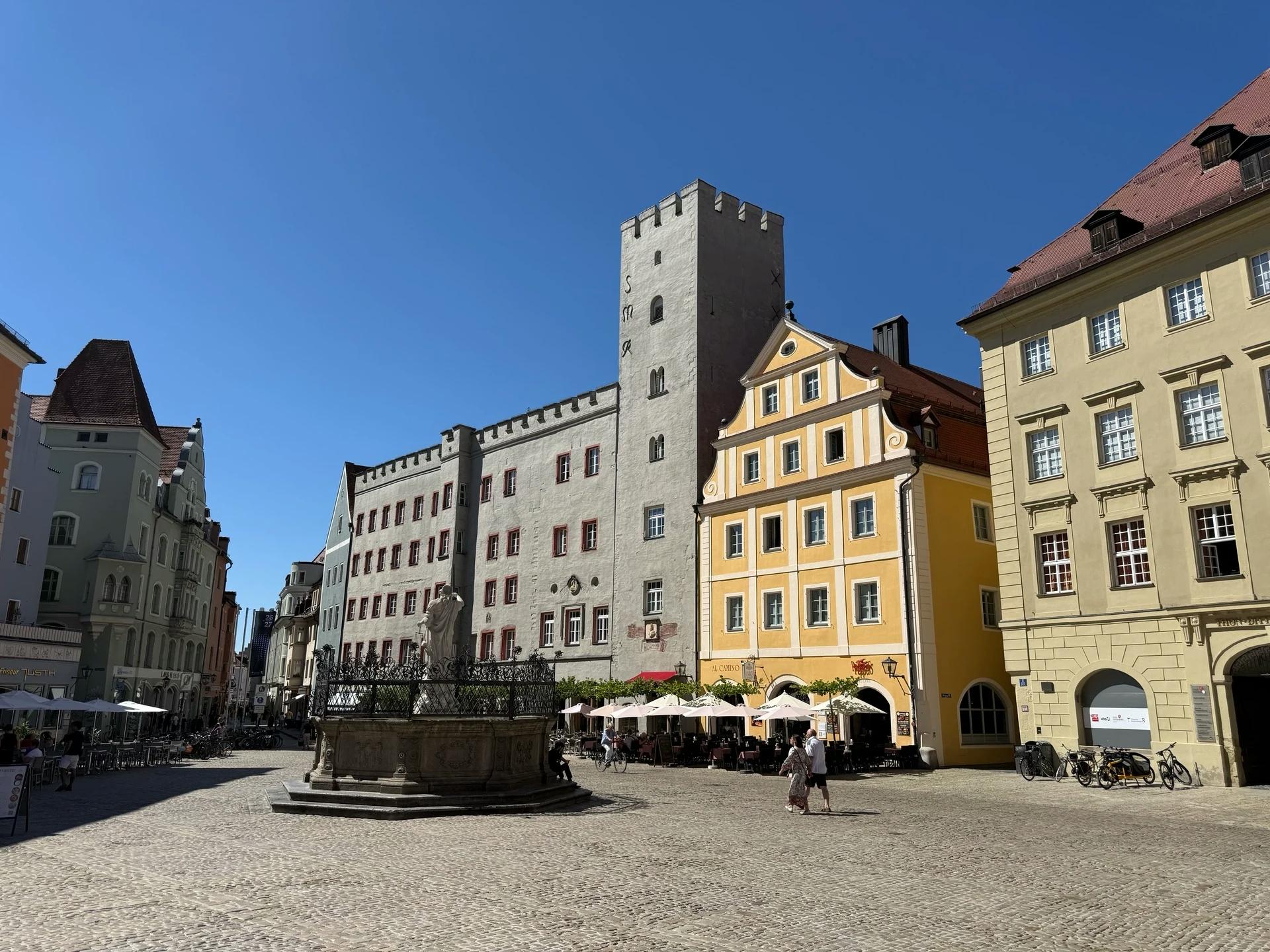
Haidplatz square and historic buildings in Regensburg Old Town
ART & CULTURE
Museums & Cultural Experiences
Regensburg’s museums explore Bavaria’s modern history and life on the Danube, while memorials reveal stories that are less visible in the streets. Theater and independent craft add a contemporary dimension. Farther afield, Walhalla, Weltenburg Abbey, Schulerloch cave and the Befreiungshalle broaden the choice with monumental architecture, religious art and natural scenery. The entries below begin in the city and finish with nearby sights featured in the main guide’s longer itineraries.
Haus der Bayerischen Geschichte
The museum beside the Danube follows Bavaria from the creation of the kingdom in 1806 to the present. It provides useful context for the royal monuments, regional traditions and Bavarian identity encountered elsewhere during a visit. This is a substantial museum rather than a quick stop, and a good option when poor weather makes outdoor sightseeing less appealing.
Donau-Schiffahrts-Museum
The museum ships introduce the working Danube, shifting attention from scenic river views to navigation and life aboard. Their setting is part of the experience: you explore this history on the river itself. The museum ships normally open April to October. Check their current hours and boarding arrangements before visiting. If you also plan to see the Haus der Bayerischen Geschichte, give each enough time or choose the subject that interests you most.
Theater Regensburg
I have a personal connection to Theater Regensburg from a school trip when we came here to see Der Freischütz. A performance adds another dimension to a stay, especially after a day spent exploring the city’s historic buildings.
The main theater at Bismarckplatz is a familiar landmark, but productions use several venues. Check the location, language and performance time when choosing tickets. An evening here can be a rewarding part of the trip in its own right, with dinner before or afterward depending on the program.

Haus der Bayerischen Geschichte beside the Danube
Neupfarrplatz & Jewish History
Neupfarrplatz occupies the former medieval Jewish quarter. In 1519, the Jewish community was expelled and the quarter destroyed. Dani Karavan’s walkable memorial, Misrach, traces the former synagogue’s footprint, giving this history a visible presence in the square. Guided visits to the underground document Neupfarrplatz offer a further view of the surviving remains beneath today’s city.
Stadtamhof’s Colosseum Memorial
The memorial to prisoners of the former Colosseum subcamp of Flossenbürg concentration camp is an important historical stop in Stadtamhof. It asks visitors to look beyond the area’s attractive streets and acknowledge the suffering connected with this place. Pause to read the memorial rather than passing it as another feature along the walking route.
Independent Shops & Ceramics
Keramikwerkstatt Küffer, at Goldene-Bären-Straße 1 in the Old Town near the Stone Bridge, is a personal favorite. I have repeatedly found unusual ceramics there for my kitchen or garden. It fits into a wander through Kramgasse and the smaller lanes on the south side of the river, where independent shops make browsing worthwhile.
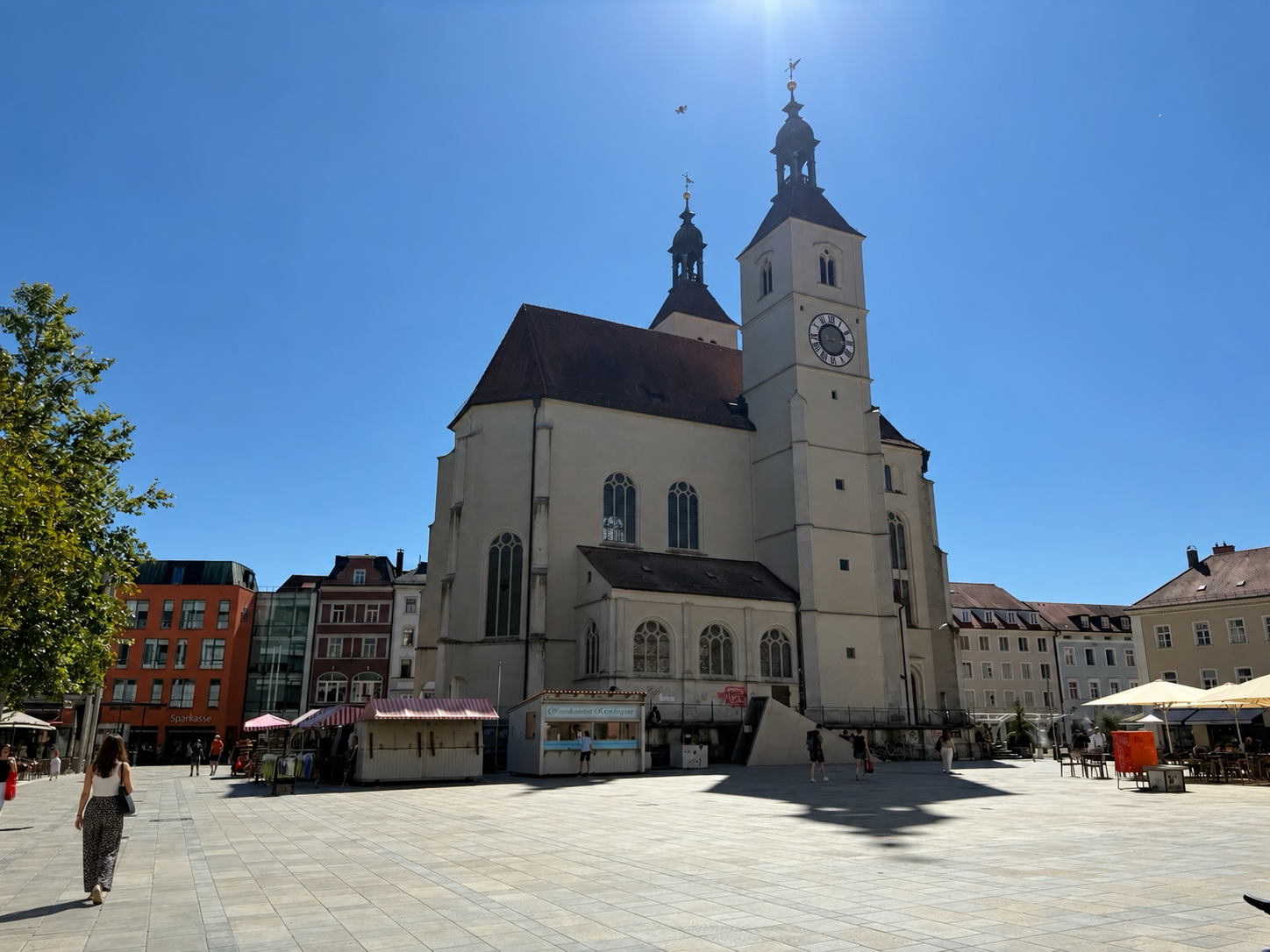
Neupfarrplatz and local shops in Regensburg
Walhalla near Donaustauf
Walhalla’s classical architecture and hillside position offer a striking contrast to medieval Regensburg. Commissioned by King Ludwig I, the memorial hall honors distinguished figures from German-speaking history, while its terraces overlook the Danube plain. I have visited several times, including once by bicycle. The riverside approach involves a long stair climb; check alternative access if needed. My Day Four itinerary covers bicycle, seasonal boat and RVV bus 5 options; each approach still requires planning for the climb.
Weltenburg Abbey & the Danube Gorge
Weltenburg Abbey combines an abbey church, a monastery beer garden and a remarkable setting beside the limestone Danube Gorge. We visited as a family when I was younger, and the excursion has stayed with me. The regular seasonal gorge boats run from Kelheim, operated by Vereinigte Schifffahrtsunternehmen Kelheim; a departure from Regensburg is a separate excursion, not the same service. Day Three explains the driving route and a boat alternative. Check Kelheim–Weltenburg departures and water-level notices. Drivers should use the village visitor car park and set navigation to avoid ferries; check the Klosterschenke’s seasonal hours before planning lunch.
Schulerloch near Essing
A guided visit to Schulerloch takes you underground, adding a natural attraction to the churches and monuments around Regensburg. Allow about 20 minutes for the uphill walk from the car park before the tour, and bring a jacket for the cool cave interior. The cave closes on Mondays outside Bavarian school holidays and in winter, currently from 9 November 2026 through March 2027. Check the operator’s seasonal calendar before leaving. This is the first stop in my Day Three driving itinerary, before Weltenburg and Kelheim.
Befreiungshalle above Kelheim
The Befreiungshalle stands above Kelheim, with a monumental interior and views across the surrounding landscape. Seeing it from below gives only part of the impression: approaching the building and stepping inside reveals its scale. It makes a distinctive final stop after Schulerloch and Weltenburg in the Day Three itinerary, bringing together a cave, an abbey beside the river and a hilltop monument.

Walhalla monument rising above the wooded Danube Valley
Final Thoughts
A good Regensburg visit does not require entering every landmark. Choose a few churches, museums or guided tours that match your interests, then enjoy the streets, squares and river views between them. For a longer stay, the nearby cave, abbey and hilltop monuments add variety. The main guide’s itineraries show how these choices can fit into four days, while the Areas & Parks page covers places for a quieter walk or an outdoor break.