

Salzburg See & Do
Explore a hilltop fortress, Baroque churches and squares, Mozart history, modern art, public sculpture and an internationally renowned performance tradition.
OVERVIEW
Sights Worth Exploring
Hohensalzburg Fortress and the cathedral are good starting points for Salzburg’s architecture, while Mozart’s two homes tell different parts of his family’s story. DomQuartier adds state rooms and art collections; the Museum der Moderne has exhibitions at two locations.
Most central sights fit into a walking route, but museum and church visits need separate time. I would choose the visits that interest you most, then use the squares and riverside streets to connect them.
LANDMARKS & SIGHTS
Attractions to Explore
Begin on the left bank with Getreidegasse, the cathedral squares and the fortress. Mirabell is across the Salzach. You can walk between these areas, but allow extra time for the fortress ascent and museum and church visits.
Festung Hohensalzburg
Festungsbahn valley station: Festungsgasse 4, 5020 Salzburg
The fortress is one of the sights I would prioritize on a first visit. Its courtyards and bastions overlook the city, while the museums and princely rooms explain its military role and the lives of Salzburg’s rulers.
Allow roughly 1½–2 hours to explore, longer if you want to see the exhibitions in detail. Choose a fortress ticket with the Festungsbahn ascent included if you want to ride up. Footpath tickets have different inclusions, so compare the official ticket options rather than assuming every ticket covers the same rooms and journey. The cobbled walking approach is steep; there are also steps and changes of level within the fortress.
Planned maintenance: The Festungsbahn operator lists closures on 9–13 November 2026 and 11 January–14 March 2027. Check current operating notices and fortress access separately before visiting.
Getreidegasse
Mozart’s birthplace is at number 9 on this historic shopping street. Look up at the wrought-iron signs and into the passageways linking courtyards and neighboring streets.
I prefer walking here early or later in the day, when there are fewer tour groups. If you plan to visit shops or the birthplace, check their hours separately; a quiet early walk does not necessarily coincide with opening time.
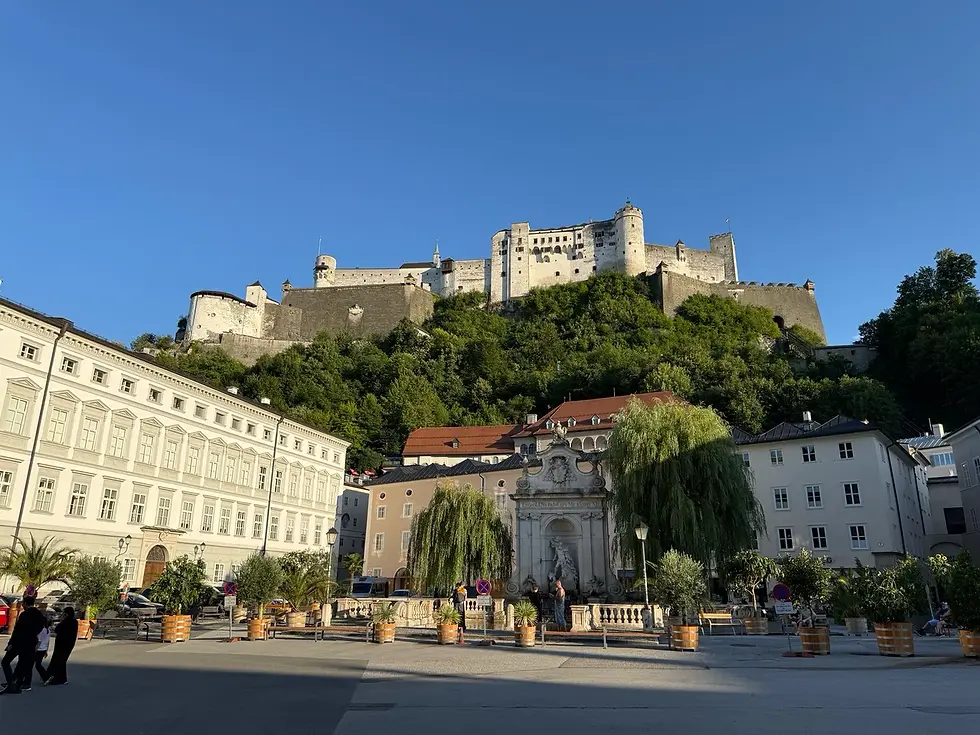
Salzburg fortress as seen from the Kapitelplatz
Residenzplatz & the Cathedral Squares
Residenzplatz, with its large Baroque fountain, connects to Mozartplatz and Domplatz. Continue to Kapitelplatz for the approach toward the fortress. This makes a practical walking sequence between the Residenz, cathedral and Festungsbahn.
During festivals and major events, temporary structures can change access through these squares. Leave room to adjust your route.
Sphaera
Stephan Balkenhol’s Sphaera stands on Kapitelplatz: a male figure on an oversized golden sphere, with the fortress above. It is one of my favorite pieces of public art in Salzburg and easy to include while walking between the cathedral and fortress.

Sphaera sculpture in Kapitelplatz
Schloss Mirabell
The gardens are the main reason to stop at Mirabell, with formal flowerbeds, fountains and views toward the fortress. Admission is free, although parts of the gardens close in winter.
The palace is also used by the city administration, so most rooms are not open for sightseeing. Check access to the Marble Hall if you want to see it; events can affect visiting hours.
Salzburg Cathedral
Visit the cathedral interior for its Baroque architecture as well as the exterior seen from Domplatz. Check the sightseeing schedule around services and special events.
During our July 2026 visit, festival preparations prevented us from visiting as planned. Check current access if your visit coincides with work around Domplatz.
St. Peter’s Abbey Church & Cemetery
St. Peter’s church and cemetery are close to the cathedral and can be visited together. The spaces known as the catacombs are carved into the cliff and reached by steps, with separate admission.
Allow time to look around quietly, respecting worshippers and people visiting graves. Check church and catacomb access separately.

Ornate Baroque interior of Salzburg Cathedral, with high altar
ART & CULTURE
Museums & Cultural Experiences
For Mozart’s childhood, start at his birthplace; for the family’s later Salzburg years, choose Mozart-Wohnhaus. DomQuartier covers historic state rooms and religious art, while the Museum der Moderne focuses on modern and contemporary work.
Mozarts Geburtshaus
Mozart was born at Getreidegasse 9 in 1756. The museum presents his family and early musical life through historic rooms, portraits, documents and instruments.
Allow about an hour as a starting estimate. An early visit can pair well with a quieter walk along Getreidegasse. If visiting both Mozart museums, compare their combined ticket with separate admission and the Salzburg Card, which includes one visit to each museum. Check current hours before setting out.
Mozart-Wohnhaus
The family moved to the larger residence at Makartplatz 8 in 1773. This museum is across the Salzach from the birthplace and focuses on the family’s later life in Salzburg.
Plan it with Mirabell and the right-bank streets to avoid retracing your route. Visiting both houses adds context, but each is a separate museum with its own entrance.

Mozart Monument on Mozartplatz with Hohensalzburg Fortress in the background
Museum der Moderne Salzburg
The museum has two locations: the Mönchsberg building above the city and the Rupertinum in the Altstadt. Check which building hosts the exhibition you want to see.
For the Mönchsberg site, take the lift from Anton-Neumayr-Platz or walk uphill. The outdoor views and surrounding paths can be enjoyed separately from the galleries; compare museum and lift ticket options if doing both.
DomQuartier Salzburg
DomQuartier connects the Residenz state rooms with the cathedral-arcade terrace, organ gallery, cathedral museum and St. Peter’s Long Gallery. These spaces offer views across the squares and down into the cathedral, alongside collections explaining the power and wealth of Salzburg’s prince-archbishops. Current building work changes parts of the route.
Allow 1½–2 hours for the available circuit. The Residenzgalerie is closed for construction, expected through autumn 2027; the cathedral-arcade terrace is currently reached only through the Dommuseum, and other areas can have day-specific restrictions. Last admission is one hour before closing. Tuesday is normally the closing day, with seasonal exceptions. Check the current closure notices and current access before planning your visit.
Plan your visit: DomQuartier opening days and last admission.

Museum der Moderne terrace and façade on Salzburg’s Mönchsberg.
Performances in Salzburg
The Salzburg Festival presents opera, theater and concerts in summer. If attending matters to you, choose the performance before fixing your sightseeing schedule and allow time for dinner, the walk to the venue and admission.
Check the performance language, any surtitles and the running time. The festivals guide covers the main seasonal events; the summer festival is only one part of Salzburg’s music calendar.
The Sound of Music
The film is not a personal interest of mine, and I have not taken one of the tours. Several American friends, however, have loved seeing the filming locations.
Compare the actual stops before choosing a tour. Some stay within Salzburg, while others travel into the lake district. Check whether stops include interior access or only an exterior view, and allow for the total journey time.

Two bronze sculptures framing a Salzburg old-town street and distant Hohensalzburg Fortress.
Final Thoughts
Group Mozart’s birthplace with Getreidegasse, DomQuartier with the cathedral squares, Mozart-Wohnhaus with Mirabell, and the Mönchsberg museum with a hilltop walk. Check exhibition locations, opening days and the time you need inside before buying tickets. Compare a sightseeing pass against the places you actually plan to visit, and allow for the steep fortress approach if the funicular is closed.