

Germany · Bavaria
Rothenburg ob der Tauber
Medieval walls, timbered streets and a quieter evening above the Tauber Valley.
Quick Facts
The Essentials
LOCATION
Franconia, northern Bavaria, Germany
POPULATION
Around 11,300
CURRENCY
Euro (€)
Plan Your Time
RECOMMENDED STAY
1 full day; 1–2 nights for a slower visit
GETTING AROUND
On foot; steps, cobbles and valley slopes
BEST TIME
Year-round; plan walks and indoor stops around the weather
The Highlights
KNOWN FOR
Medieval walls, half-timbered houses and Plönlein
DON'T MISS
Town walls, Burggarten views and the Night Watchman
INTRODUCTION
Why Visit
I have visited Rothenburg ob der Tauber a handful of times, usually by train from Nuremberg. Entering through a fortified gate still makes a strong impression. Narrow lanes lead past timbered houses and small squares, while towers and red-tiled roofs appear above the city wall. It is a popular town, and the busiest streets can feel crowded, but there is plenty to enjoy beyond the familiar view of Plönlein.
My favorite part is walking sections of the wall and looking into the Tauber Valley. From the Burggarten, Rothenburg’s position high above the river becomes clear. The landscape is an important part of the visit, so I would leave time for the viewpoints rather than filling the day with shops and museums.
On a December visit with a friend from San Francisco, we stayed at Villa Mittermeier and walked to the Rathaus for the Night Watchman tour. The Christmas market was in full swing, and the tour was a lovely experience. As we walked along the old town walls overlooking the Tauber Valley, a light mist began to settle. I may earn a commission if you book through these hotel links.
By the time we finished, it had become much colder and the mist had frozen on the cobblestones. I have never encountered more slippery conditions. Even the slight uphill walk back to our hotel was difficult, and we saw cars sliding on the icy streets. We finally made it back to a lovely dinner in a basement dining room with vaulted ceilings. That was a welcome end to quite an adventurous evening.
One full day covers the main sights; a second gives you room for a museum and the valley below. Rothenburg’s medieval townscape is remarkably coherent, although parts of the eastern Old Town and walls were rebuilt after Second World War damage. Those repairs, including the donor names along the wall, are part of its history too.
Browse my Rothenburg ob der Tauber guide for ideas and practical tips, or visit Plan & Book to find accommodations, transportation and activities for your trip.

Red-tiled roofs and half-timbered houses cluster around a stone clock tower in Rothenburg.
EXPLORE MORE
Plan Your Visit


OVERVIEW
Practical Information
How Long to Stay
Allow one full day for the main streets, a section of wall, St. Jakob and the Burggarten. One night makes the Night Watchman tour and an early walk easier; a second local day adds a museum and the Tauber Valley without rushing. Choose a room inside or close to the walls if you want to explore on foot.
Where to stay
Rothenburg has typically been a day trip from Nuremberg for me. The one time I stayed overnight was with a friend from San Francisco, and we chose Villa Mittermeier, a charming private inn by the Würzburg Gate, close to the city center. We had a great stay, and I particularly enjoyed the creative and personal touches throughout the property, including in my entry-level single room. Dinner in what I recall as a vaulted cellar was very good. I may earn a commission if you book through these hotel links.
Getting to Rothenburg
In this section you can find a range of information about how to travel to and from Rothenburg ob der Tauber. You can research and book flights, trains and buses, and ferries on Omio to find options that suit your specific trip. Please note that I may earn a commission through this link.
By train: Search for Rothenburg ob der Tauber as your destination in DB Navigator. The final connection normally uses the RB82 branch line from Steinach (bei Rothenburg ob der Tauber). From the station, follow Bahnhofstraße and Ansbacher Straße to Rödertor; allow roughly 10–15 minutes with luggage or stops. Check official arrival information.
From Nuremberg: Search from Nürnberg Hbf. A usual regional route changes at Ansbach and Steinach before the RB82 to Rothenburg. Allow around 1½–2 hours as a planning estimate, and check the complete outward and return connection for your date, especially for an evening tour.
By car: Follow signs to the visitor parking areas outside the walls and continue on foot. If staying overnight, ask your accommodation about luggage access and parking before entering the narrow streets.
Walking, Tickets and Access
The Old Town is best explored on foot. Cobbles, uneven steps, low beams and narrow passages make the elevated wall walk unsuitable for some visitors; the streets below provide an alternative. The Tauber Valley adds a substantial climb back to town. In winter, light mist can freeze on the cobbles as temperatures fall, making even gentle slopes difficult. Wear shoes with good grip, check conditions before an evening tour and avoid wall or valley paths when icy. Steinach station is currently listed as not barrier-free, so check the full rail route if step-free access matters.
The streets, city wall and Burggarten are free to explore; churches, towers, museums and guided tours may charge separately. The Deutschlandticket covers eligible local and regional services, generally excluding ICE, IC and EC trains. Compare current regional day tickets if you do not already hold one, and check its validity for your exact journey.
Seasons and Weather
Rothenburg has warm summers and cold winters. Figures are based on 1991–2020 German Weather Service averages; ranges span the three monthly averages in each season, not extremes. Wet days have at least 1 mm (0.04 in) of precipitation, including snow.
THROUGH THE YEAR
When to Visit
Explore the guides below for practical tips, things to see and do, local food, events and ideas for trips beyond your destination.
SPRING
Add paragraph text. Click “Edit Text” to update the font, size and more. To change and reuse text themes, go to Site Styles.
Add paragraph text. Click “Edit Text” to update the font, size and more. To change and reuse text themes, go to Site Styles.
SUMMER
Add paragraph text. Click “Edit Text” to update the font, size and more. To change and reuse text themes, go to Site Styles.
Add paragraph text. Click “Edit Text” to update the font, size and more. To change and reuse text themes, go to Site Styles.

FALL
Add paragraph text. Click “Edit Text” to update the font, size and more. To change and reuse text themes, go to Site Styles.
Add paragraph text. Click “Edit Text” to update the font, size and more. To change and reuse text themes, go to Site Styles.
Add paragraph text. Click “Edit Text” to update the font, size and more. To change and reuse text themes, go to Site Styles.
WINTER
Add paragraph text. Click “Edit Text” to update the font, size and more. To change and reuse text themes, go to Site Styles.
Add paragraph text. Click “Edit Text” to update the font, size and more. To change and reuse text themes, go to Site Styles.
EXPLORE
Neighborhoods & Parks
The Spital Quarter
Spitalgasse and Spital Bastion, at the southern end of the Old Town · Map
South of Plönlein, continue down Spitalgasse toward the hospital complex and bastion. This part of town feels less concentrated around the main postcard view, with residential lanes, fortifications and space to pause. Combine it with the southern wall walk rather than making a separate trip across town.
Burggarten and the Western Lanes
Burggarten, through Burgtor at the western end of Herrngasse · Map
Walk through Herrngasse and the Burgtor to the Burggarten, laid out on the site of the former castle. The garden’s views across the Tauber Valley are among my favorite parts of Rothenburg. From here, the town’s high defensive position becomes much easier to understand.
On the way back, explore the lanes around Klostergasse and the former Dominican convent. Small detours from the busiest shopping streets make the walk more varied without adding much distance.

Down into the Tauber Valley
Doppelbrücke, Taubertalweg, below the Old Town · Map
For a longer outing, follow a marked route downhill toward the Doppelbrücke, the double bridge below town. The river, wooded slopes and views back toward the walls give Rothenburg a different scale. The small Topplerschlösschen at Taubertalweg 100, built in 1388 for Mayor Heinrich Toppler, combines a small residence with a defensive tower. It can be included on a longer valley circuit. It stands on private property; check appointment arrangements for a visit rather than assuming you can enter.
Allow time and energy for the climb back. This is a better second-day walk than an extra stop squeezed between museums. In persistent rain, ice or poor visibility, stay with the upper-town lanes and use the RothenburgMuseum instead. In August, the Taubertal Festival takes place on the Eiswiese below town, so check the event dates before planning a quiet valley walk.
Tip: Save the valley walk for clear weather and comfortable shoes.
EXPERIENCE
Festivals & Events
Meistertrunk and Imperial City Days
At Pentecost, the historic Meistertrunk festival retells Rothenburg’s best-known legend through performances, costumes and processions. The Imperial City Festival in early September brings historical groups into the Old Town. Both make accommodation and restaurant planning more important than on an ordinary weekday.
Rothenburg Wine Village
The Rothenburg Wine Village brings regional wine and food to the old-town setting in August.
Taubertal Festival
I have not attended the Taubertal Festival yet, but I have always been impressed that a major rock and pop festival takes place right below Rothenburg’s walls. I think it would be a great experience for anyone who enjoys live music, and a very different reason to visit in August.
The concerts take place on the Eiswiese in the Tauber Valley, with designated camping areas separate from the concert grounds. Check the official festival website for current dates, tickets, camping and arrival or shuttle arrangements, and plan accommodation early.
The Reiterlesmarkt
Rothenburg’s Reiterlesmarkt fills the squares and lanes around the Town Hall with stalls, lights and seasonal food from late November until shortly before Christmas. Check the official market dates for your year; the market is closed on 22 November 2026. Winter evenings are cold, so alternate time outdoors with a café or museum break.
Use the official events calendar for your travel year, festival programmes and any changes before reserving a room.
Tip: Book an overnight stay early if your visit coincides with a major festival.
PLAN YOUR TIME
Suggested Itineraries
The first day connects Rothenburg’s main sights on foot. A second local day leaves room for the southern quarter, a museum and the valley below. Put the longer outdoor route on the clearer day, and check seasonal openings before setting out.
ONE DAY
Day 1: Walls, Old Town and the Night Watchman
A full walking day inside the walls, with an evening worth staying for.
Morning
Rödertor and the walls: Enter through Rödertor and walk a manageable wall section toward the southern gates; use the streets below if steps or low beams are difficult.
Plönlein and lunch: Continue to Plönlein and along Schmiedgasse toward the Marktplatz, stopping for lunch nearby.
Winter opening hours: In winter, move St. Jakob into the morning if its shorter visiting hours require it.
Afternoon
St. Jakob and Burggarten: Visit St. Jakob and its Holy Blood Altarpiece, then walk through Herrngasse to the Burggarten for the valley views.
Weather alternative: If rain settles in, shorten the garden stop and visit the nearby RothenburgMuseum; in clear weather, explore the western lanes at an easier pace.
Evening
Dinner and the Night Watchman: Have dinner in the Old Town and return to the Marktplatz for the Night Watchman tour, if running in your language.
Final stroll: Finish with a short walk through the quieter central streets, or leave in good time for your confirmed train connection.
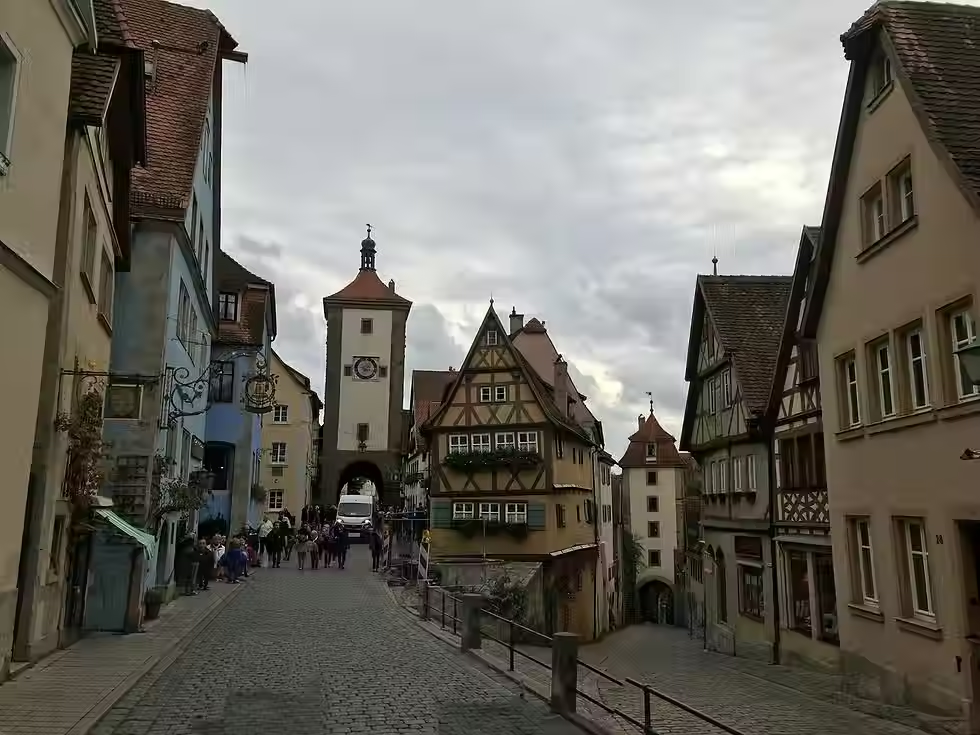
Two tower gateways frame a yellow half-timbered house at a cobbled junction in Rothenburg.
TWO DAYS
Day 2: Spital Quarter and the Tauber Valley
A slower second day with a choice between a valley walk and more time indoors.
Morning
Spital Quarter: Return to Plönlein early, then continue along Spitalgasse to the hospital quarter and Spital Bastion.
Museum and lunch: Walk back toward Burggasse and choose the Medieval Crime and Justice Museum, leaving time for lunch nearby.
Afternoon
Tauber Valley: In clear weather, follow a marked route into the Tauber Valley toward the Doppelbrücke, allowing enough time for the uphill return.
Weather alternative: In rain or icy conditions, stay in the upper town for the German Christmas Museum and a café; check seasonal hours before choosing an indoor stop.
Evening
Dinner or departure: Make a final circuit of the lanes around Herrngasse and the Market Square, with dinner if you are staying a second night.
Last look: Collect any bakery purchases and allow time to walk back to the station, or use the quieter hour for a last view from Burggarten before dark.

A covered town-wall walkway overlooks red-tiled roofs and a narrow street in Rothenburg.
CONTINUE
Nearby Cities & Journeys
Nuremberg
About 100 km by road; allow roughly 1¼–1½ hours by car or 1½–2 hours by regional train, usually with changes. Nuremberg adds an imperial castle, major museums and a much larger city’s history. It is the base I have most often used for Rothenburg. Explore Nuremberg.
Würzburg
About 65 km by road; allow approximately 45–60 minutes by car or 1–1½ hours by regional train, normally changing at Steinach. The Residence, Main riverfront and Franconian wine culture make it a different kind of stop. Give the city a separate day rather than combining it with your first Rothenburg visit.
Bamberg
About 150 km by road; allow roughly 1½–1¾ hours by car, depending on traffic. Its river setting, cathedral quarter and brewing traditions suit an onward overnight stay. By rail, several changes make this a longer journey; check the actual connection rather than treating Bamberg as a quick excursion. Explore Bamberg.
My Nuremberg to Rothenburg Journey
The original journey guide brings the rail approach and a full-day walking route together. It is useful if you are visiting from Nuremberg and deciding whether to return that evening or stay overnight. The times above are planning estimates; check the actual connection and road route for your date. Nuremberg to Rothenburg journey.
Tip: Treat another Franconian city as an onward stop if repeated train changes would use most of your day.
My Tips for Your Visit
I would give Rothenburg one night if your schedule allows, with time for the walls, the Tauber Valley views, one museum and a good meal. Staying late makes the Night Watchman tour easier, while an early walk gives you quieter streets. If you come by train, check the changes at Ansbach and Steinach and your last return before setting out. Save the valley walk for suitable weather and leave enough energy for the climb back.

DISCOVER
Attractions & Museums
TASTE
Food Culture
Most visits to Rothenburg, except for one, have always been daytrips for me. But when we stayed overnight, we had a wonderful meal at Villa Mittermeier. This was many years ago, but judging by current online reviews, the inn continues to place great detail to offering visitors a nice experience. The old town center around the Marktplatz and Plönlein offer plenty of cafés and traditional Franconian restaurants.

Town Walls and Fortified Gates
Wall access: Rödertor, at the eastern entrance · Map
Enter through Rödertor for a good introduction to Rothenburg’s defenses. The roughly four-kilometer Tower Trail follows the fortifications, with sections on the covered walkway and others at ground level. There is no need to complete the circuit: a stretch toward Spitaltor gives you roofs, towers and countryside views.

The substantial Spital Bastion rewards a closer look at the southern end. Along the wall, notice the donor inscriptions associated with its postwar restoration. Use the streets below whenever the narrow walkway, stairs or low beams are uncomfortable.

Plönlein and the Market Square
Plönlein; continue north along Schmiedgasse to Marktplatz · Map
At Plönlein, two streets divide around a small half-timbered house, framed by the Siebers and Kobolzell towers. The junction is smaller than photographs suggest, so keep the route clear when stopping. Early morning or later evening is often quieter for photographs. Continue along Schmiedgasse to the Marktplatz, with its Town Hall and former council tavern.

The Town Hall tower offers an elevated view when open, but the final climb is steep and narrow. Nearby, the Historiengewölbe presents the Thirty Years’ War and the Meistertrunk story. Treat the mayor’s enormous wine-drinking feat as a local legend, not established history.
St. Jakob’s Church
St. Jakob, Kirchplatz · Map
A short walk from the square brings you to St. Jakob, whose great treasure is Tilman Riemenschneider’s Holy Blood Altarpiece, carved at the beginning of the 16th century. The Gothic church is more restrained than Bavaria’s lavish Baroque churches. Give the woodcarving time and check sightseeing hours around services, especially during the shorter winter opening period.
Medieval Crime and Justice Museum
Burggasse 3–5 · Map
A substantial collection about European law, punishment and social order, with much more context than a display of torture devices. Allow at least an hour for this visit. Visitor information.
RothenburgMuseum
Klosterhof 5 · Map
Art and town history in the former Dominican convent, useful for understanding the Free Imperial City and its everyday life. It is a good indoor choice near St. Jakob and the western lanes. Visitor information.
German Christmas Museum
Herrngasse 1 · Map
The history of German Christmas customs and decorations, above the Käthe Wohlfahrt Christmas complex. It offers a seasonal subject throughout the year, beyond the outdoor market. Visitor information.
Alt-Rothenburger Handwerkerhaus
Alter Stadtgraben 26 · Map
A smaller view of domestic and working life in an old craftsman’s house. Opening is seasonal, generally Easter through October, so check before walking over. Visitor information.
The Night Watchman
Meeting point: Marktplatz, in front of the Rathaus · Map
I particularly enjoy the Night Watchman tour. The roughly one-hour walk uses stories and humor to explain the town’s history. The English tour normally starts at 8 p.m. and runs daily during the main season, with a reduced winter schedule and holiday exceptions. Check the current tour schedule and your return connection before making plans. The official schedule lists no tour on 31 October 2026.
Traditional Food
Rothenburg’s traditional food brings together Franconian tavern dishes, wines from the surrounding region and the town’s recognizable pastries. One of them is called Schneeballen, and I should admit that they are not the thing for me. I find the pastry dry and the chocolate glaze greasy, although they are clearly popular with locals and visitors alike. While I generally don’t drink, Franconian and Tauber wines are worth asking about (I am told).
The selections below give you several ways to try the regional cooking without making every stop a large roast dinner.

Fried pastry balls with sugar or chocolate coatings.
Schneeballen
Schneeballen are balls of fried shortcrust pastry sold with powdered sugar, chocolate and other coatings. They are popular, but I have never liked them: the pastry tastes dry to me and the chocolate glaze greasy. Others enjoy them, so this is a local specialty to judge for yourself.

Regional sausages vary in recipe and size.
Franconian bratwurst
Franconian bratwurst comes in different regional recipes and sizes, commonly served with bread or sauerkraut. The seasoning, texture and preparation vary between towns and butchers. A Rothenburg menu therefore need not offer the same sausage as another Franconian city.

Crisp crackling is part of Schäufele’s appeal.
Schäufele
Schäufele is roasted pork shoulder with crisp crackling, often served with dumplings and gravy. Its appeal lies in the contrast between tender meat and crunchy skin. It is a substantial Franconian roast rather than a small sausage-and-bread meal.

Poached bratwurst offers an alternative to the grilled version.
Blaue Zipfel
Blaue Zipfel are Franconian bratwurst gently poached in a tangy onion broth rather than grilled. The sausages remain tender, while the broth and softened onions become part of the dish. The name describes the preparation, not an additional type of filling.

Regional wines include whites such as Silvaner.
Franconian and Tauber wines
Franconian and Tauber wines offer a regional accompaniment to meals in Rothenburg, including whites such as Silvaner. The rounded, flat-sided Bocksbeutel is a familiar Franconian bottle. The producer and origin still matter, since not every wine on a local menu comes from the immediate valley.

Spiced sauce gingerbread can enrich Franconian Sauerbraten.
Franconian Sauerbraten
Franconian Sauerbraten is beef marinated and slowly braised until tender, with a gently sweet-sour sauce often thickened and seasoned with spiced sauce gingerbread. Potato dumplings and red cabbage are traditional accompaniments. The precise seasoning varies between kitchens.
THROUGH THE YEAR
When to Visit
Explore the guides below for practical tips, things to see and do, local food, events and ideas for trips beyond your destination.
SPRING
Spring (March–May)
Climate: Average lows 1–8°C (33–46°F) and average highs 10–19°C (49–66°F); 8–10 wet days per month.
Seasonal highlight: Der Meistertrunk brings historical performances at Pentecost, which can fall in May or June.
Outdoors and clothing: Wear layers and sturdy shoes for the cobbled old town and the sloping paths down into the Tauber Valley.
Add paragraph text. Click “Edit Text” to update the font, size and more. To change and reuse text themes, go to Site Styles.
SUMMER
Summer (June–August)
Climate: Average lows 11–13°C (52–55°F) and average highs 23–25°C (73–77°F); 9–10 wet days per month.
Seasonal highlight: The Taubertal Festival brings rock music to the valley in August.
Outdoors and clothing: Carry water for the climb back from the Tauber Valley and a light jacket for evening walks along the town walls.
Add paragraph text. Click “Edit Text” to update the font, size and more. To change and reuse text themes, go to Site Styles.
FALL
Fall (September–November)
Climate: Average lows 2–9°C (35–48°F) and average highs 8–20°C (46–67°F); 8–10 wet days per month.
Seasonal highlight: The Reichsstadt-Festtage brings historical groups into the Old Town in early September.
Outdoors and clothing: Choose a warmer layer and grippy shoes for damp cobbles and leaf-covered paths into the Tauber Valley.
WINTER
Winter (December–February)
Climate: Average lows −2–−1°C (28–30°F) and average highs 3–5°C (38–41°F); 10–13 wet days per month.
Seasonal highlight: The Reiterlesmarkt fills the center from late November until shortly before Christmas.
Outdoors and clothing: Pack thermal layers and sturdy footwear for the market and exposed wall walks, and watch for ice on cobbled slopes.
Add paragraph text. Click “Edit Text” to update the font, size and more. To change and reuse text themes, go to Site Styles.
Tip: Check the last train before deciding to stay for the Night Watchman tour.