
Nuremberg to Coburg
Royal palaces, colorful squares and a fortress above Franconia
OVERVIEW
Why Make this Journey
I have visited Coburg only once, but it immediately struck me as one of Franconia’s most charming small cities. The broad Markt is surrounded by colorful historic façades, while gateways such as the Spitaltor lead into quieter streets that still feel closely connected to the former ducal court. Look upward and Veste Coburg dominates the hillside above everything. What makes the town especially interesting is how much European royal history is concentrated here. Prince Albert, Queen Victoria’s husband, grew up in and around Coburg, and the House of Saxe-Coburg and Gotha became connected to royal families across Europe. On a day trip, you can walk through the old center, visit Ehrenburg Palace, climb through the Hofgarten to the fortress and stop for a Coburger Bratwurst on the Markt. The center is compact, attractive and easy to enjoy without an elaborate plan, although the fortress and palace interiors make advance planning worthwhile.
For the direct regional route, check VGN’s RE19 through Fürth, Erlangen, Forchheim and Bamberg toward Coburg. Ebermannstadt is not a stop on that service. Other services can use the Lichtenfels route; follow the stops for your actual train.
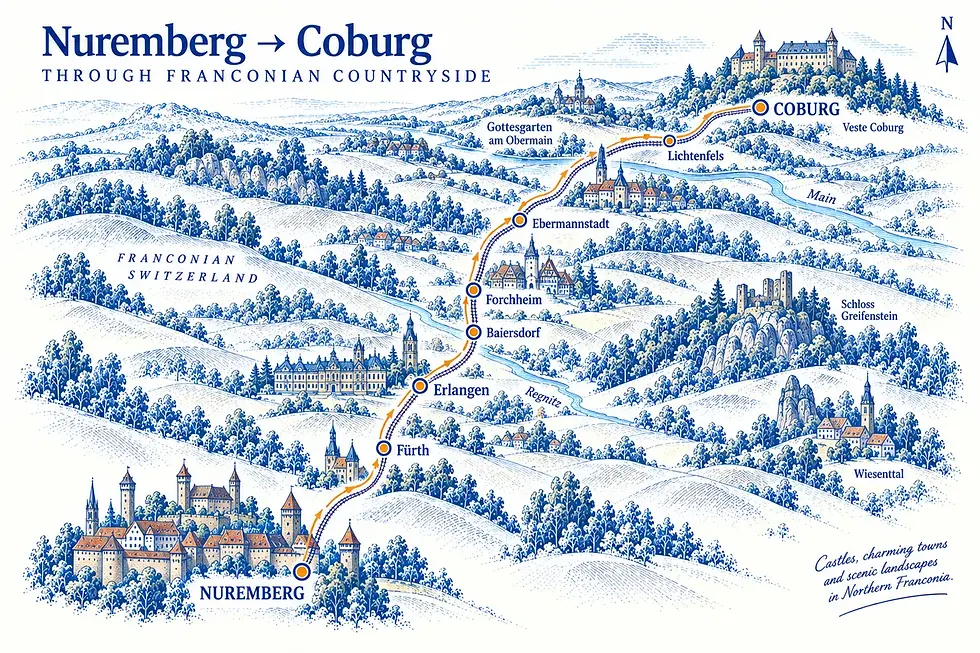
Illustrated route from Nuremberg to Coburg through Franconian countryside, passing Fürth, Erlangen, Forchheim and Lichtenfels.
EXPLORE
Places & Experiences
Enter the Old Town Through the Spitaltor
From Coburg station, allow approximately 15 minutes to walk into the historic center. One attractive approach leads along Spitalgasse and through the Spitaltor, the northern entrance to the old town.
Originally constructed in the 13th century, the Spitaltor is one of only two surviving gates from Coburg’s medieval fortifications. Beyond the gate, the street becomes increasingly lively, with shops, cafés and colorful façades leading toward the Markt. Learn more about the Spitaltor
Explore the Markt
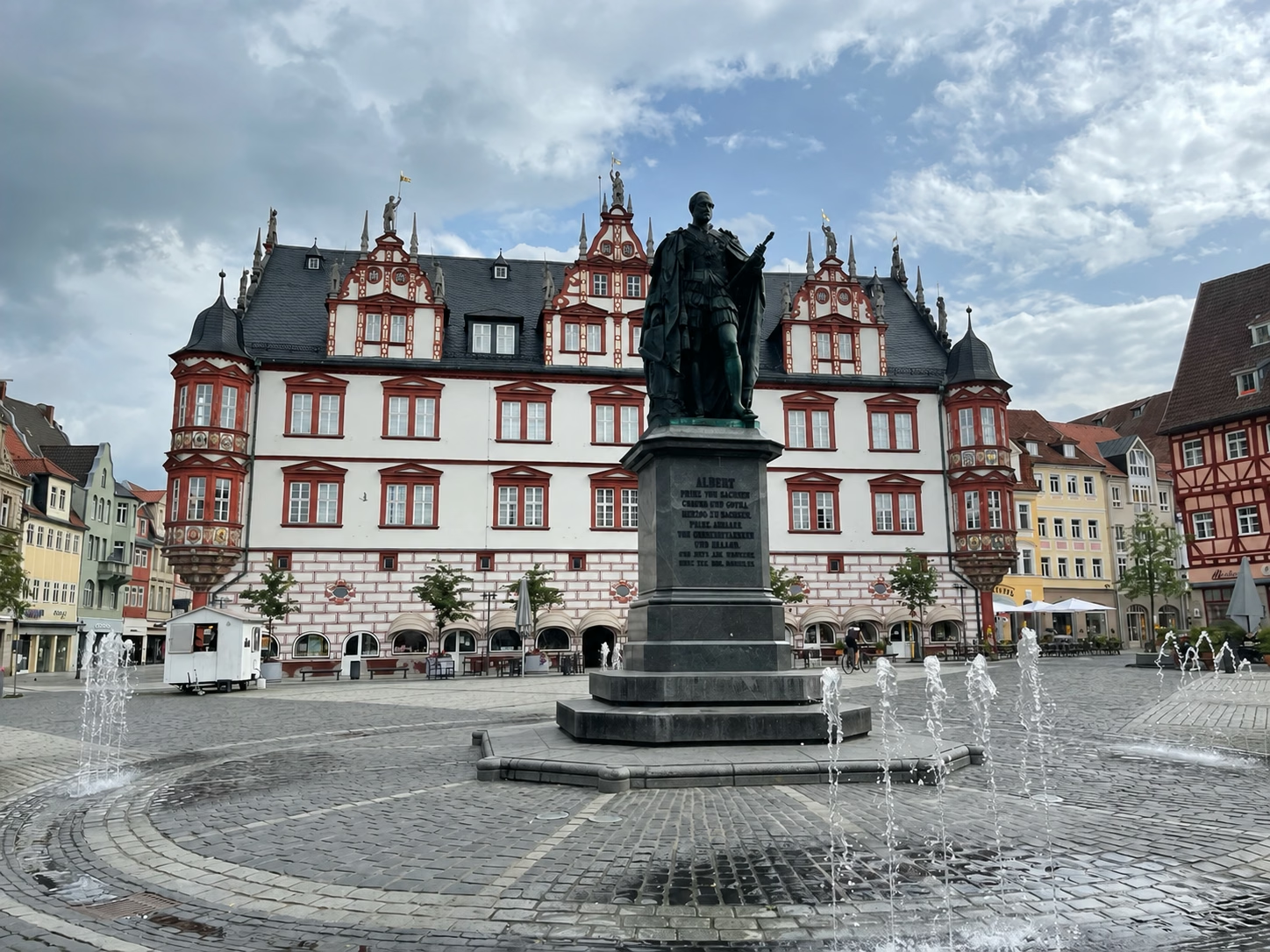
Coburg’s Markt is the visual heart of the city and the place that made the strongest impression on me. It is broad, open and surrounded by a particularly attractive collection of historic buildings. The Renaissance Rathaus and the Stadthaus face one another across the square, while a monument to Prince Albert stands near its center.
Take time to walk around the entire square rather than simply crossing it. Look at the decorated façades, rooflines and architectural details. Even the manhole covers reflect local history: they carry the image of Saint Maurice, Coburg’s patron saint and the figure on the city’s coat of arms.
Locals sometimes call the Saint Maurice figure on the Rathaus the Bratwurstmännle. His marshal’s staff is humorously said to represent the correct length of a traditional Coburger Bratwurst.
Follow the Royal History
Coburg was the seat of the small but remarkably influential Duchy of Saxe-Coburg and Gotha. Rather than gaining prominence through conquest, members of its ruling family married into royal houses across Europe.
The most important British connection came through Prince Albert, who was born at nearby Rosenau Palace and married Queen Victoria in 1840. Their descendants occupied several European thrones, and the British royal dynasty officially carried the Saxe-Coburg and Gotha name from 1901 until it was renamed Windsor in 1917.
Other members of the Coburg family became monarchs of Belgium, Portugal and Bulgaria. This history explains why a relatively small Franconian city contains such an impressive collection of palaces, monuments and royal residences.
Visit St. Moriz Church
Walk from the Markt to St. Moriz, Coburg’s principal Protestant church. Its interior includes an elaborate alabaster tomb monument to Duke Johann Friedrich II and his family.
Martin Luther preached here while staying at Veste Coburg in 1530. He had been placed under an imperial ban and could not travel safely to Augsburg, so he remained at the fortress for almost six months while following the events of the Diet of Augsburg from a distance.
Tour Ehrenburg Palace
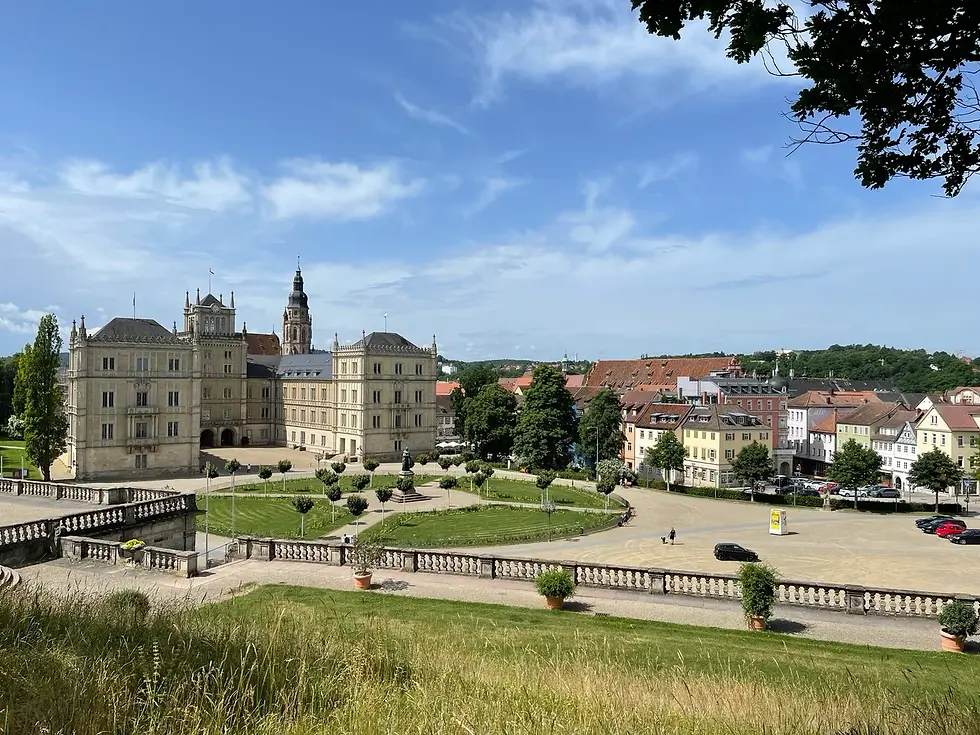
Continue to Schlossplatz and Ehrenburg Palace, the former city residence of the Coburg dukes. Its imposing Gothic Revival exterior dates primarily from the 19th century, but the palace developed from a Renaissance residence completed in the 16th century.
The historic rooms include elaborate Baroque interiors, the palace church, the Hall of Giants and apartments connected with Queen Victoria and Prince Albert. The interiors are generally visited on a scheduled guided tour, so check the times before planning the rest of your day. If you do not take the tour, the palace exterior and spacious Schlossplatz are still essential stops.
Try a Coburger Bratwurst
Before walking up to the fortress, return to the Markt for Coburg’s best-known local food. A Coburger Bratwurst is longer and more coarsely ground than the small sausages associated with Nuremberg. Traditionally, it is grilled over dried pinecones, which give it a distinctive smoky flavor.
Buying one from a stand on the Markt is both an inexpensive lunch and part of the local experience. For a larger meal, traditional restaurants serve Franconian dishes such as Schäufele, roasts and Coburger Klöße—potato dumplings that traditionally contain toasted bread cubes.
Walk Through the Hofgarten
Behind Ehrenburg Palace, the Hofgarten climbs toward Veste Coburg. The landscaped park provides the most attractive walking route between the center and the fortress, with lawns, mature trees, monuments and views back toward the old town.
Allow approximately 30–40 minutes for the uphill walk from Schlossplatz to the fortress. The incline is sustained but manageable for most reasonably active visitors. A bus or taxi is a better choice for travelers with limited mobility or during very hot, wet or icy weather.
Explore Veste Coburg
Veste Coburg, sometimes called the “Franconian Crown,” is one of Germany’s largest and best-preserved fortress complexes. Its elevated position provides wide views over Coburg and the surrounding countryside.
Martin Luther lived at the fortress from April until October 1530. The rooms associated with his stay form part of the castle’s history, but the museum collections extend well beyond the Reformation. Displays include weapons and armor, historic carriages and sleighs, glass, prints and paintings by Lucas Cranach the Elder and his workshop.
Allow at least 90 minutes for the fortress and closer to two hours if you enjoy art and historical collections. Even visitors who skip the museum should walk through the courtyards and enjoy the views.
Return for Coffee and a Final Walk
After descending through the Hofgarten, return to the center for coffee, cake or a final walk through the pedestrian streets. Coburg is compact enough that you can wander without worrying about becoming lost. Colorful buildings, quiet historic streets and architectural details are as important to Coburg’s character as its major monuments.

Coburg’s Rathaus and colorful historic façades surrounding the cobblestoned Markt.
How to Get There
By ICE: The fastest direct trains from Nürnberg Hauptbahnhof reach Coburg in approximately 50–60 minutes. These trains require a separate long-distance ticket and are not covered by the Deutschland-Ticket.
By regional train: Direct regional services generally take around 70 minutes, although some connections are longer. Regional trains are covered by the Deutschland-Ticket under its normal conditions.
By car: Allow approximately 1 hour 30 minutes, depending on traffic. A car is unnecessary for the central itinerary but helpful if you want to add Rosenau or Callenberg Palace.
From Coburg station: The Markt is approximately a 15-minute walk.
Always check current schedules, as the balance between ICE and regional departures changes throughout the day.
Getting Around Coburg
Explore the station area, Spitaltor, Markt, St. Moriz, Ehrenburg Palace and Schlossplatz on foot.
Walk through the Hofgarten to reach Veste Coburg.
Use a local bus or taxi to avoid the uphill walk to the fortress.
A car is most useful for outlying palaces rather than the center.
Wear comfortable shoes because the route includes cobblestones, park paths and a substantial climb.
Recommended Itinerary
Morning: Arrive through the Spitaltor, explore the Markt and visit St. Moriz.
Late morning: Tour Ehrenburg Palace if the schedule allows.
Lunch: Try a Coburger Bratwurst on the Markt or eat at a traditional restaurant.
Afternoon: Walk through the Hofgarten to Veste Coburg and visit its collections.
Late afternoon: Return to the center for coffee, shopping or another walk before taking the train back to Nuremberg.
How Much Time to Allow
Minimum: Six hours in Coburg for the center, Schlossplatz and a shorter fortress visit.
Recommended: Seven to nine hours for the complete walking route, Ehrenburg Palace and Veste Coburg.
With an overnight stay: Add Rosenau Palace, Callenberg Palace, additional museums or an evening performance.
Who Will Enjoy This Trip?
Choose Coburg for royal history, palace interiors and the walk through the Hofgarten to the fortress. If the uphill route is difficult, use a bus or taxi. Reserve or check the Ehrenburg tour first, then arrange the rest of the day around it.
Should You Stay Overnight?
A standard visit to Coburg works well as a day trip from Nuremberg, especially when using a fast train. An overnight stay becomes worthwhile if you want to explore several royal properties or attend an event.
The most important addition is Rosenau Palace near Rödental, where Prince Albert was born and spent part of his childhood. The palace stands within an English-style landscape park and can be reached by regional transportation or car. It deserves several hours and should not be squeezed into the standard Coburg itinerary.
Callenberg Palace, west of the center, remains closely connected to the House of Saxe-Coburg and Gotha. It is another worthwhile addition for visitors with a strong interest in the ducal family.
For a one-day visit, I would prioritize the center, Ehrenburg and Veste Coburg rather than trying to include all three palace complexes.
What Makes Coburg Special?
Coburg combines the intimacy of a small Franconian city with an unusually international history. Members of its ducal family became connected to royal houses throughout Europe, yet the city remains relaxed and manageable.
The physical arrangement also makes the history easy to understand. The former ducal residence stands beside the old town, the Hofgarten climbs behind it and the great medieval fortress watches over everything from the hill above. Few cities of this size offer such a complete sequence of market square, palace, park and fortress.
Coburg also has a somewhat different historical identity from many Bavarian cities. It was formerly associated with Saxon and Thuringian territories and only became part of Bavaria in 1920. Locals generally identify strongly with Franconian rather than southern Bavarian culture.
Is It Expensive?
Coburg can be a moderately priced day trip:
Regional transportation can be inexpensive if already covered by a Deutschland-Ticket.
ICE travel saves time but may cost considerably more when booked close to departure.
Walking around the center, Schlossplatz and Hofgarten is free.
Ehrenburg Palace and the Veste charge separate admission.
A Coburger Bratwurst provides an inexpensive local lunch.
Combination or family tickets may reduce museum costs.
An overnight stay is usually more affordable outside major festival weekends.
Major Events
International Samba Festival: Usually held in July; check the organizer's dates for your travel year. Around 3,000 performers and tens of thousands of visitors transform the old town into a large celebration of Brazilian music, dance and street culture. It is promoted as the largest samba festival outside Brazil. Official festival website
Schlossplatzfest: A summer festival around Ehrenburg Palace with music, performances, food and illuminated historic surroundings, generally held in July.
Coburger Vogelschießen: A traditional folk festival with rides, beer tents and entertainment, usually held from late July into early August.
HUK-Coburg Open-Air-Sommer: A series of major outdoor concerts held during the summer months.
Christmas Market: The Markt becomes the setting for Coburg’s Advent market, surrounded by the illuminated Rathaus, Stadthaus and colorful historic façades.
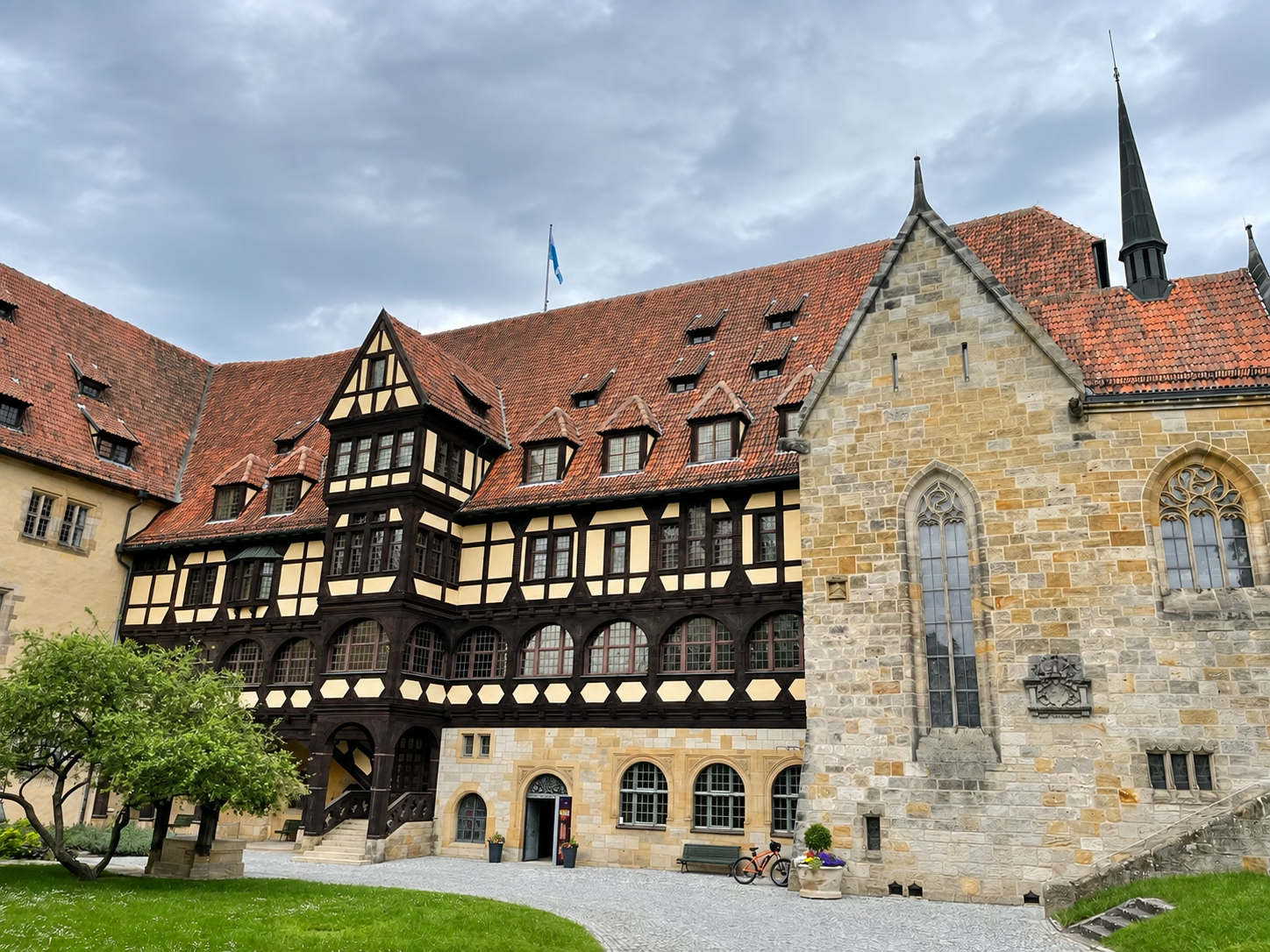
Half-timbered buildings and the stone castle chapel surrounding a courtyard inside Veste Coburg.