

Rothenburg ob der Tauber
Medieval walls, timbered streets and a quieter evening above the Tauber Valley.
LOCATION
Franconia, northern Bavaria, Germany
POPULATION
Around 11,300
CURRENCY
Euro (€)
RECOMMENDED STAY
1 full day; 1–2 nights for a slower visit
GETTING AROUND
On foot; steps, cobbles and valley slopes
BEST TIME
Year-round; plan walks and indoor stops around the weather
KNOWN FOR
Medieval walls, half-timbered houses and Plönlein
DON'T MISS
Town walls, Burggarten views and the Night Watchman
INTRODUCTION
Why Visit
I have visited Rothenburg ob der Tauber four or five times, usually by train from Nuremberg. Entering through a fortified gate still makes a strong impression. Narrow lanes lead past timbered houses and small squares, while towers and red-tiled roofs appear above the city wall. It is a popular town, and the busiest streets can feel crowded, but there is plenty to enjoy beyond the familiar view of Plönlein.
My favorite part is walking sections of the wall and looking into the Tauber Valley. From the Burggarten, Rothenburg’s position high above the river becomes clear. The landscape is an important part of the visit, so I would leave time for the viewpoints rather than filling the day with shops and museums.
On one visit, we stayed at Villa Mittermeier and had a wonderful meal there. The creative rooms and relaxed evening made that stay particularly memorable. An overnight visit also makes it easier to join the Night Watchman tour, which I particularly enjoy, and walk the streets again before the larger groups arrive.
One full day covers the main sights; a second gives you room for a museum and the valley below. Rothenburg’s medieval townscape is remarkably coherent, although parts of the eastern Old Town and walls were rebuilt after Second World War damage. Those repairs, including the donor names along the wall, are part of its history too.

Red-tiled roofs and half-timbered houses cluster around a stone clock tower in Rothenburg.
EXPLORE MORE
Plan Your Visit


PLAN YOUR TIME
Suggested Itineraries
The first day connects Rothenburg’s main sights on foot. A second local day leaves room for the southern quarter, a museum and the valley below. Put the longer outdoor route on the clearer day, and check seasonal openings before setting out.
ONE DAY
Day 1: Walls, Old Town and the Night Watchman
A full walking day inside the walls, with an evening worth staying for.
Morning
Enter through Rödertor and walk a manageable wall section toward the southern gates; use the streets below if steps or low beams are difficult.
Continue to Plönlein and along Schmiedgasse toward the Marktplatz, stopping for lunch nearby.
In winter, move St. Jakob into the morning if its shorter visiting hours require it.
Afternoon
Visit St. Jakob and its Holy Blood Altarpiece, then walk through Herrngasse to the Burggarten for the valley views.
If rain settles in, shorten the garden stop and visit the nearby RothenburgMuseum; in clear weather, explore the western lanes at an easier pace.
Evening
Have dinner in the Old Town and return to the Marktplatz for the Night Watchman tour, if running in your language.
Finish with a short walk through the quieter central streets, or leave in good time for your confirmed train connection.
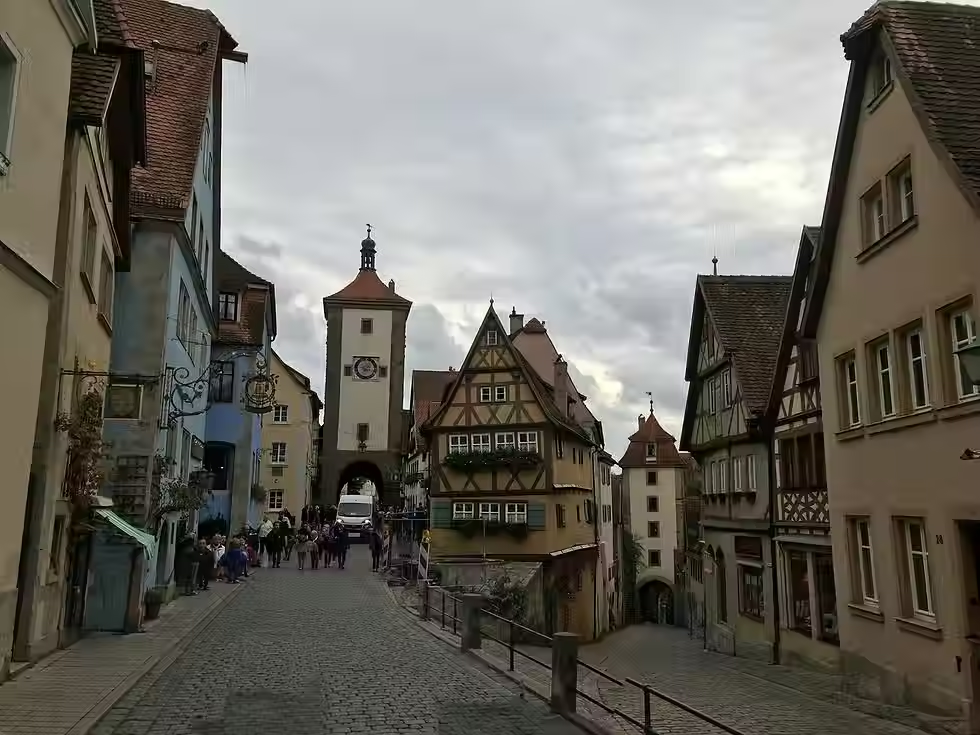
Two tower gateways frame a yellow half-timbered house at a cobbled junction in Rothenburg.
TWO DAYS
Day 2: Spital Quarter and the Tauber Valley
A slower second day with a choice between a valley walk and more time indoors.
Morning
Return to Plönlein early, then continue along Spitalgasse to the hospital quarter and Spital Bastion.
Walk back toward Burggasse and choose the Medieval Crime and Justice Museum, leaving time for lunch nearby.
Afternoon
In clear weather, follow a marked route into the Tauber Valley toward the Doppelbrücke, allowing enough time for the uphill return.
In rain or icy conditions, stay in the upper town for the German Christmas Museum and a café; check seasonal hours before choosing an indoor stop.
Evening
Make a final circuit of the lanes around Herrngasse and the Market Square, with dinner if you are staying a second night.
Collect any bakery purchases and allow time to walk back to the station, or use the quieter hour for a last view from Burggarten before dark.

A covered town-wall walkway overlooks red-tiled roofs and a narrow street in Rothenburg.
My Tips for Your Visit
I would give Rothenburg one night if your schedule allows. Staying late and starting early leaves more time to enjoy the streets when they are quieter.
Keep the walls and Tauber Valley views central to the plan. A single museum, a good meal and the Night Watchman tour add more to the experience than trying to enter every attraction.
If you come by train, check the connection through Steinach and the last return before setting out. Leave the valley walk for suitable weather rather than forcing it into a wet or rushed afternoon.


OVERVIEW
Practical Information
How Long to Stay
Allow one full day for the main streets, a section of wall, St. Jakob and the Burggarten. One night makes the Night Watchman tour and an early walk easier; a second local day adds a museum and the Tauber Valley without rushing. Choose a room inside or close to the walls if you want to explore on foot.
Getting to Rothenburg
By train: The final connection normally uses the RB82 branch line from Steinach (b. Rothenburg ob der Tauber). This is different from Stein near Nuremberg. From Rothenburg station, allow about 10–15 minutes to reach the eastern Old Town and Rödertor on foot.
From Nuremberg: Regional journeys commonly take around 1¼–1¾ hours with changes, often at Ansbach and Steinach. Check the complete outward and return connection, particularly if staying for an evening tour.
By car: Follow signs to the visitor parking areas outside the walls and continue on foot. If staying overnight, ask your accommodation about luggage access and parking before entering the narrow streets.
Walking, Tickets and Access
The Old Town is best explored on foot. Cobbles, uneven steps, low beams and narrow passages make the elevated wall walk unsuitable for some visitors; the streets below provide an alternative. The Tauber Valley adds a substantial climb back to town. Steinach station is currently listed as not barrier-free, so check the full rail route if step-free access matters.
The streets, city wall and Burggarten are free to explore; churches, towers, museums and guided tours may charge separately. The Deutschlandticket covers eligible local and regional services, generally excluding ICE, IC and EC trains. Compare current regional day tickets if you do not already hold one, and check its validity for your exact journey.
Seasons and Weather
1991–2020 German Weather Service averages for Rothenburg ob der Tauber. Ranges span the three monthly averages in each season, not temperature extremes. Wet days have at least 1 mm (0.04 in) of precipitation, which can include snow.
Spring (March–May)
Spring begins with chilly mornings and gradually turns mild, with more rainfall toward May.
Average lows 1–8°C (33–46°F) and average highs 10–19°C (49–66°F); 8–10 wet days per month.
Seasonal highlight: Der Meistertrunk brings historical performances at Pentecost, which can fall in May or June.
Outdoors and clothing: Wear layers and sturdy shoes for the cobbled old town and the sloping paths down into the Tauber Valley.
Summer (June–August)
Summer afternoons are warm, evenings cool down, and showers remain possible.
Average lows 11–13°C (52–55°F) and average highs 23–25°C (73–77°F); 9–10 wet days per month.
Seasonal highlight: The Taubertal Festival brings rock music to the valley below Rothenburg in August.
Outdoors and clothing: Carry water for the climb back from the Tauber Valley and a light jacket for evening walks along the town walls.
Fall (September–November)
September can still feel mild, but days cool quickly and evenings turn chilly as autumn progresses.
Average lows 2–9°C (35–48°F) and average highs 8–20°C (46–67°F); 8–10 wet days per month.
Seasonal highlight: The Reichsstadt-Festtage brings historical groups and encampments to the old town on the first weekend of September.
Outdoors and clothing: Choose a warmer layer and grippy shoes for damp cobbles and leaf-covered paths into the Tauber Valley.
Winter (December–February)
Winter brings cold days and nights often below freezing, with rain or snow possible.
Average lows −2–−1°C (28–30°F) and average highs 3–5°C (38–41°F); 10–13 wet days per month.
Seasonal highlight: The Reiterlesmarkt fills Rothenburg’s medieval center from late November through December.
Outdoors and clothing: Pack thermal layers and sturdy footwear for the market and exposed wall walks, and watch for ice on cobbled slopes.
Climate sources: temperature and station records. Historical averages are a planning guide, not a forecast.
Tip: Check the last train before deciding to stay for the Night Watchman tour.
DISCOVER
Attractions & Museums
Town Walls and Fortified Gates
Enter through Rödertor for a good introduction to Rothenburg’s defenses. The roughly four-kilometer Tower Trail follows the fortifications, with sections on the covered walkway and others at ground level. There is no need to complete the circuit: a stretch toward Spitaltor gives you roofs, towers and countryside views.
The substantial Spital Bastion rewards a closer look at the southern end. Along the wall, notice the donor inscriptions associated with its postwar restoration. Use the streets below whenever the narrow walkway, stairs or low beams are uncomfortable.
Plönlein and the Market Square
At Plönlein, two streets divide around a small half-timbered house, framed by the Siebers and Kobolzell towers. The junction is smaller than photographs suggest, so keep the route clear when stopping. Continue along Schmiedgasse to the Marktplatz, with its Town Hall and former council tavern.
The Town Hall tower offers an elevated view when open, but the final climb is steep and narrow. Nearby, the Historiengewölbe presents the Thirty Years’ War and the Meistertrunk story. Treat the mayor’s enormous wine-drinking feat as a local legend, not established history.
St. Jakob’s Church
A short walk from the square brings you to St. Jakob, whose great treasure is Tilman Riemenschneider’s Holy Blood Altarpiece, carved at the beginning of the 16th century. The Gothic interior is more restrained than Bavaria’s lavish Baroque churches. Give the woodcarving time and check sightseeing hours around services.
Choose a Museum
Medieval Crime and Justice Museum: A substantial collection about European law, punishment and social order, rather than simply a display of torture devices.
RothenburgMuseum: Art and town history in the former Dominican convent, useful for understanding the Free Imperial City and its everyday life.
German Christmas Museum: The history of German Christmas customs and decorations, with an indoor alternative beyond the seasonal market.
Alt-Rothenburger Handwerkerhaus: A smaller view of domestic and working life in an old craftsman’s house; check its seasonal opening before walking over.
The Night Watchman
I particularly enjoy the Night Watchman tour. The roughly one-hour walk starts at the Market Square and uses stories and humor to explain the town’s history. English and German walks have different evening times, and the schedule becomes more limited in winter. Check the current tour information and your return connection before making plans.
EXPLORE
Neighborhoods & Parks
The Spital Quarter
South of Plönlein, continue down Spitalgasse toward the hospital complex and bastion. This part of town feels less concentrated around the main postcard view, with residential lanes, fortifications and space to pause. Combine it with the southern wall walk rather than making a separate trip across town.
Burggarten and the Western Lanes
Walk through Herrngasse and the Burgtor to the Burggarten, laid out on the site of the former castle. The garden’s views across the Tauber Valley are among my favorite parts of Rothenburg. From here, the town’s high defensive position becomes much easier to understand.
On the way back, explore the lanes around Klostergasse and the former Dominican convent. Small detours from the busiest shopping streets make the walk more varied without adding much distance.
Down into the Tauber Valley
For a longer outing, follow a marked route downhill toward the Doppelbrücke, the double bridge below town. The river, wooded slopes and views back toward the walls give Rothenburg a different scale. The small Topplerschlösschen can be included on a longer valley circuit; an interior visit requires checking its separate arrangements.
Allow time and energy for the climb back. This is a better second-day walk than an extra stop squeezed between museums. In persistent rain, ice or poor visibility, stay with the upper-town lanes and use the RothenburgMuseum instead.
Tip: Save the valley walk for clear weather and comfortable shoes.
TASTE
Food & Drink
We had a wonderful meal during our stay at Villa Mittermeier. For a simpler lunch, I would choose an appealing historic inn after looking at the menu. These local and Franconian specialties give you a useful starting point.
Schneeballen: Strips of fried pastry shaped into a ball, traditionally dusted with sugar and also sold with chocolate or other coatings; one is often enough to share, and the plain version can be dry.
Franconian bratwurst: Regional sausages served with bread or sauerkraut, with recipes and sizes that vary across Franconia.
Schäufele: Roasted pork shoulder with crisp crackling, often accompanied by dumplings and gravy.
Blaue Zipfel: Franconian bratwurst gently poached in a tangy broth with onions, an alternative to the grilled version.
Franconian and Tauber wines: Look for local whites such as Silvaner, or ask what is available by the glass rather than assuming every bottle comes from the immediate valley.
Where to Stop
The lanes around the Marktplatz and Plönlein have plenty of inns and cafés, though a few streets away can feel quieter. Bakeries work well for a lighter breakfast or an afternoon pause. Compare menus before sitting down, especially if you want something small rather than a full meal.
For dinner at a particular restaurant, reserve ahead on festival weekends and during the Christmas market. My Villa Mittermeier recommendation comes from that earlier stay; check its current dining offer and opening days when planning your own visit.
Tip: Share a Schneeball first before buying several different versions.
EXPERIENCE
Festivals & Events
Meistertrunk and Imperial City Days
At Pentecost, the historic Meistertrunk festival retells Rothenburg’s best-known legend through performances, costumes and processions. The Imperial City Festival in early September brings historical groups into the Old Town. Both make accommodation and restaurant planning more important than on an ordinary weekday.
Summer Wine and Music
The Rothenburg Wine Village brings regional wine and food to the old-town setting in August. The Taubertal Festival, also usually in August, is a much larger rock and alternative-music event in the valley. Its site, transport arrangements and crowds differ from the central sightseeing area, so check the event information before booking.
The Reiterlesmarkt
Rothenburg’s Christmas market fills the squares and lanes around the Town Hall with stalls, lights and seasonal food. The official 2026 dates are 20 November–23 December, with the market closed on 22 November. Winter evenings are cold, so alternate time outdoors with a café or museum break.
Use the official events calendar for your travel year, festival programmes and any changes before reserving a room.
Tip: Book an overnight stay early if your visit coincides with a major festival.
CONTINUE
Nearby Cities & Journeys
Nuremberg
About 100 km by road; allow roughly 1¼–1½ hours by car or 1¼–1¾ hours by regional train, usually with changes. Nuremberg adds an imperial castle, major museums and a much larger city’s history. It is the base I have most often used for Rothenburg.
Würzburg
About 65 km by road; allow approximately 45–60 minutes by car or 1–1½ hours by regional train, normally changing at Steinach. The Residence, Main riverfront and Franconian wine culture make it a different kind of stop. Give the city a separate day rather than combining it with your first Rothenburg visit.
Bamberg
About 150 km by road; allow roughly 1½–1¾ hours by car, depending on traffic. Its river setting, cathedral quarter and brewing traditions suit an onward overnight stay. By rail, several changes make this a longer journey; check the actual connection rather than treating Bamberg as a quick excursion.
My Nuremberg to Rothenburg Journey
The original journey guide brings the rail approach and a full-day walking route together. It is useful if you are visiting from Nuremberg and deciding whether to return that evening or stay overnight. The times above are planning estimates; check the actual connection and road route for your date.
Tip: Treat another Franconian city as an onward stop if repeated train changes would use most of your day.