

Vienna See & Do
Move from imperial palaces and opulent churches to major art collections, city history, music and playful modern landmarks.
OVERVIEW
Sights Worth Exploring
For a first visit, I would start with Stephansdom and the Hofburg, then choose a palace visit around your interests: Schönbrunn for imperial rooms and extensive grounds, or Upper Belvedere for Austrian art, including Klimt’s The Kiss. The Wien Museum helps explain the city beyond its imperial image. My own favorites also include the MAK, an evening performance and the Prater’s roller coasters and ghost trains. Below, I explain what each place offers and the practical differences that matter when planning a visit.
Paid Link Browse Vienna activities and tours.
LANDMARKS & SIGHTS
Attractions to Explore
Stephansdom, Peterskirche and the Hofburg fit naturally into a walk through the Innere Stadt. Karlskirche pairs well with the Wien Museum on Karlsplatz. Schönbrunn needs a separate trip west on the U4, while the Prater and Donauturm take you toward the Danube. Treat Spittelau as an optional architecture detour, especially if Hundertwasser interests you.
CATHEDRAL
Stephansdom
I have visited Vienna’s cathedral repeatedly, including early in the morning when it was relatively quiet, and explored the catacombs on an earlier trip. The Gothic interior is worth seeing, but decide separately whether you want a tower view or an underground tour.
Planning tip: The South Tower involves 343 stairs; the North Tower has a lift and houses the Pummerin bell. Catacombs are visited on guided tours. These have distinct admission arrangements, and sightseeing access is affected by services.
IMPERIAL PALACE
Schönbrunn Palace
Schönbrunn combines Habsburg palace interiors with formal gardens, the uphill walk to the Gloriette and Tiergarten Schönbrunn. We spent our latest visit mainly outdoors. I would allow at least half a day for the palace and grounds, and most of a day if adding the zoo.
Planning tip: Take the U4 to Schönbrunn. Palace tours have fixed entry times and differ in the rooms included. The main park is free; the zoo and selected garden attractions require admission. Allow for the uphill walk and exposed paths in hot weather.
IMPERIAL COMPLEX
Hofburg
The Hofburg contains several separate attractions. Choose the Sisi Museum and Imperial Apartments for court life, the Imperial Treasury for crowns and dynastic treasures, or the Austrian National Library’s State Hall for its Baroque interior. Spanish Riding School training sessions and performances are another distinct visit. I find the complex’s scale easiest to appreciate on foot.
Planning tip: Walk from Michaelerplatz through the courtyards toward Heldenplatz. There is no single admission covering everything listed here; check the exact attraction and inclusions. The Silver Collection is currently closed.
CHURCH
Karlskirche
I have returned several times to this Baroque church on Karlsplatz. Its paired columns and dome make the exterior distinctive; inside, look for Johann Michael Rottmayr’s dome fresco. Current visitor access includes the organ loft and the panoramic terrace above the entrance.
Planning tip: Combine it with the neighboring Wien Museum. The terrace looks across Karlsplatz; it should not be confused with the elevated interior viewing arrangement I experienced on an earlier visit.
Plan your visit: Hofburg visitor updates.

The Gothic interior of St. Stephen's Cathedral in Vienna
CHURCH
Peterskirche
Just off the Graben, Peterskirche makes a short, worthwhile stop between Stephansplatz and the Hofburg. Its compact oval interior is richly decorated, with a painted dome and elaborate gilded details. The contrast between the busy shopping streets and the church interior is part of the appeal.
Planning tip: Step inside during your central walk, outside services. A separate journey across town is unnecessary.
CHURCH
Jesuitenkirche
The Jesuitenkirche on Dr.-Ignaz-Seipel-Platz was an unexpected discovery on one of my walks. Andrea Pozzo’s painted false dome is the detail to look for: perspective creates the illusion of a much deeper architectural space. My visit felt calmer than those to the churches around Stephansplatz.
Planning tip: Add it while exploring the lanes east of the cathedral. Move along the nave and look up to appreciate how the painted perspective changes.
ARCHITECTURAL LANDMARK
Hundertwasserhaus
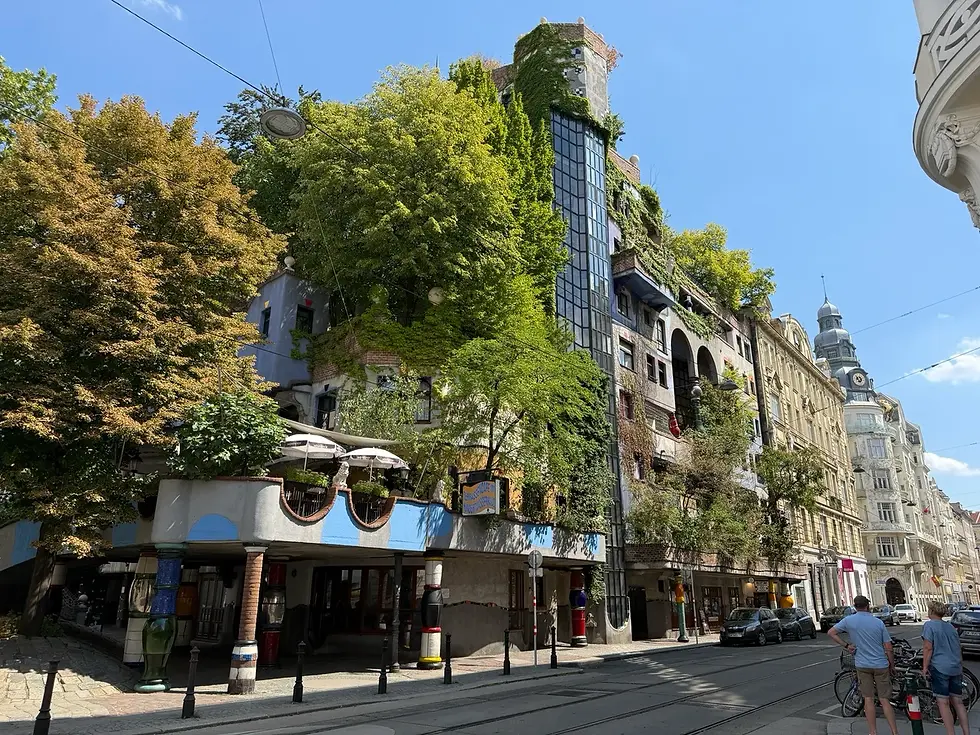
I first saw Hundertwasserhaus around age twelve and returned more than three decades later. Its irregular forms, planted terraces and bright colors still stand out. This is occupied housing at Kegelgasse and Löwengasse, so the visitor experience is the exterior, not a tour of the apartments.
Planning tip: For an indoor visit about Hundertwasser’s work, continue to Kunst Haus Wien on Untere Weißgerberstraße. It is a separate museum a short walk away.

Schönbrunn Palace seen from its entrance forecourt
AMUSEMENT PARK
Prater
The Prater remains a highlight for me. On our latest visit we spent around three hours on rides after walking through the green park along the Hauptallee. Wiener Looping was short but excellent, G’sengte Sau had enjoyable theming, and Megablitz brought back memories of earlier visits. Hotel Psycho stood out among the horror attractions, and I liked the detailed Geisterschloss. We rode a Ferris wheel too.
Planning tip: Entry to the amusement park is free; rides charge separately and keep their own operating times. Praterstern is served by U1 and U2. Our 48-hour Vienna City Card came with a Prater coupon booklet, and several two-for-one rides saved us money. Check the current offers and participating rides rather than assuming the same deal will be available.
VIEWPOINT
Donauturm
The Donauturm’s viewing terrace is 150 meters above ground. The view helped me understand the relationship between the city, the Danube, Donauinsel and Alte Donau. I would prioritize it for that broader panorama, especially in clear weather, rather than for close views of the historic center.
Planning tip: Combine it with Donaupark. From U1 Alte Donau, allow roughly 15–20 minutes to walk to the tower; account for this when comparing it with a central viewpoint.
ARCHITECTURE
Spittelau’s Hundertwasser Facade
The colorful waste-incineration plant beside Spittelau station is a working facility with a facade redesigned by Hundertwasser. It makes a worthwhile short detour for architecture enthusiasts, but I would give the palaces, museums and central churches priority on a first visit.
Planning tip: U4 and U6 serve Spittelau. View the exterior from public areas; access inside is through organized tours, not ordinary walk-in sightseeing.
Colorful Hundertwasserhaus facade in Vienna
ART & CULTURE
Museums & Cultural Experiences
Choose museums by collection, not just reputation. The Wien Museum explains Vienna’s history; the Kunsthistorisches Museum is the major Old Masters choice; Upper Belvedere and the Leopold Museum offer different perspectives on Austrian art. The Albertina combines modern art with changing exhibitions, while the MAK focuses on design and applied arts. My firsthand impressions below distinguish those visits from additional collections worth considering.
CITY HISTORY
Wien Museum
For a first visit, I now consider the Wien Museum on Karlsplatz one of the best places to begin. Its permanent exhibition connects the city’s development with politics, society and art, providing context for what you see elsewhere. The building’s terrace also offers a good view of Karlskirche.
Planning tip: The permanent exhibition is free; temporary exhibitions have separate admission arrangements. The museum normally closes on Mondays. Pair it with Karlskirche rather than crossing the city between visits.
ART MUSEUM
Albertina
The Albertina combines a collection of classical modern art with temporary exhibitions and Habsburg State Rooms. I particularly enjoyed the second-floor displays on my latest visit, though exhibitions and room access change. Its location beside the Hofburg makes it easy to combine with the historic center.
Planning tip: Check what is actually showing for your dates. ALBERTINA MODERN is a separate venue in the Künstlerhaus on Karlsplatz, with separate admission; the names are easy to confuse.
CHOOSING AN ART COLLECTION
Kunsthistorisches Museum, Leopold and mumok
These are additional options to choose by interest. The Kunsthistorisches Museum is particularly strong in Old Masters, including Pieter Bruegel the Elder, while its Kunstkammer contains objects such as Cellini’s Saliera. In the MuseumsQuartier, the Leopold Museum focuses on Austrian modernism, with a major Egon Schiele collection and Vienna around 1900. Nearby mumok focuses on modern and contemporary art.
Planning tip: For a first substantial art visit, choose the Kunsthistorisches Museum for historic European collections, Leopold for Schiele and Vienna 1900, or mumok for a more contemporary focus. MuseumsQuartier is a cultural complex, not one museum ticket.
Plan your visit: Wien Museum admission and opening days.

A giant pink bunny invites visitors into Vienna's Albertina
DESIGN & APPLIED ARTS
MAK
The Museum of Applied Arts was a wonderful surprise on our latest visit, when we saw an exhibition I found excellent. Furniture, textiles and decorative objects make it a different experience from a painting gallery. Its Vienna 1900 displays are especially useful for understanding how the city’s designers brought modern ideas into everyday objects.
Planning tip: The MAK is near U3 Stubentor and normally closes on Mondays. Tuesday evening opening until 9 p.m. can fit around daytime sightseeing; check holiday exceptions.
ART MUSEUM
Belvedere
For Klimt’s The Kiss, choose Upper Belvedere, which houses the main historic art collection. Lower Belvedere hosts temporary exhibitions, while Belvedere 21 is a separate venue for contemporary art. I have visited the Klimt collection before and returned to the gardens early on my latest trip; the view downhill from Upper Belvedere is worth pausing for.
Planning tip: The main gardens are free during their opening hours. Museum admission is separate, and standard Upper and Lower Belvedere visits require timed entry. Check the venue and ticket inclusions before choosing.

Arcaded central hall beneath a glass roof at Vienna’s MAK museum.
ART COLLECTION
Heidi Horten Collection
The Heidi Horten Collection on Hanuschgasse is convenient for the Staatsoper and Burggarten. My reaction was mixed: I found the ground-floor display more interesting than the rest of what was on show during my visit. That reflects a particular exhibition, not a permanent judgment on every display.
Planning tip: Consider it if the current modern and contemporary art program appeals to you. For a short first visit, I would give the museum that best matches your main art interest priority.
CONCERT HALL
Musikverein
I once attended a New Year’s concert at the Musikverein, and the combination of the music, setting and season remains a strong memory. When choosing a performance, check the ensemble, repertoire and hall: a concert at the Musikverein does not necessarily take place in the Golden Hall.
Planning tip: The famous Vienna Philharmonic New Year’s Concert has its own annual ticket drawing. Do not assume that another concert advertised around New Year is that event.
PERFORMING ARTS
Opera, Theater and Musicals
Seeing The Phantom of the Opera in Vienna around age twelve helped start my lasting interest in live performance. For your own evening out, compare the Staatsoper for opera and ballet, the Burgtheater for spoken drama, and the city’s musical theaters for larger stage productions.
Planning tip: Check the production’s language and available surtitles before choosing, especially for spoken theater. The Staatsoper’s regular opera and ballet season pauses in July and August, so summer visitors should check the actual program rather than assume nightly performances.

The Burgtheater across from Vienna's city hall
Final Thoughts
For a compact first visit, my priorities would be a walk through the cathedral and Hofburg area, one palace or major art collection, and the Wien Museum for context. Add the Prater if rides appeal to you; it remains one of my personal highlights. Group Karlskirche with the Wien Museum, and the Hofburg with the Albertina. Give Schönbrunn its own half-day or longer. Check museum closing days and performance dates before fixing the order.