

Germany · Bavaria
Passau
Three rivers, Baroque streets and a slower stop along the Danube.
Quick Facts
The Essentials
LOCATION
Lower Bavaria, Germany, on the Austrian border
POPULATION
Roughly 50,000
CURRENCY
Euro (€)
Plan Your Time
RECOMMENDED STAY
1 full day; 2 days for a slower overnight visit
GETTING AROUND
Walk, city bus, fortress shuttle and bicycle
BEST TIME
May–September for river walks; Advent for the market
The Highlights
KNOWN FOR
Three rivers, Baroque Old Town, cathedral organ and Danube river-cruise hub
DON'T MISS
Dreiflüsseeck, St. Stephen’s Cathedral and Veste views
INTRODUCTION
Why Visit
I first came to Passau at 12, when it was the starting point for a cycle ride along the Danube to Vienna. I have returned for day trips with my mom and Joe, and for walks on my own through the Old Town. In 2018, I passed through again on a longer ride from Ingolstadt to Bratislava. The city has become a familiar place to pause along the river.
The Old Town narrows into a peninsula between the Danube and Inn, with the Ilz joining from the far bank. I like the understated white and pastel buildings, the lanes that drop toward the water and the cathedral domes above them. From street level, the city can feel intimate; from Veste Oberhaus, its towers, spires and wooded setting come together.
Passau is also an important embarkation hub for European river cruises along the Danube. I often see cruise passengers following guides through the streets. If you are beginning or ending a voyage here, an extra night gives you time for the city beyond the walk between your transfer and the ship.
I recommend Passau particularly on warmer days, when the riverside walks are as appealing as the buildings themselves. Start with Domplatz and the cathedral, leave time for small craft shops and chocolates at Pralinenwerkstatt Greindl, then follow the water toward the Dreiflüsseeck. A day works well, while an overnight stay leaves room for the opposite bank, a museum or an evening concert.
Browse my Passau guide for ideas and practical tips, or visit Plan & Book to find accommodations, transportation and activities for your trip.

A narrow lane passing beneath arches in Passau’s old town.
EXPLORE MORE
Plan Your Visit


OVERVIEW
Practical Information
Getting There
In this section you can find a range of information about how to travel to and from Passau. You can research and book flights, trains and buses, and ferries on Omio to find options that suit your specific trip. Please note that I may earn a commission through this link.
By rail: Search for Passau Hbf (Passau Hauptbahnhof) in journey planners. Allow roughly 20–25 minutes to walk about 1.2 km (0.75 miles) east through Bahnhofstraße and Ludwigstraße to Domplatz. You pass through the modern shopping district before reaching the historic Old Town; allow longer with luggage.
From Munich: The road journey from Munich city center is about 190 km (118 miles); allow around 2 hours by car, depending on traffic. In the normal timetable, the RE 3 Donau-Isar-Express runs directly from Munich Hbf to Passau Hbf via Freising, Landshut and Plattling in around 2 hours 15 minutes. During the works, use the connection below.
From Munich Airport (MUC): The airport is about 160 km (99 miles) from Passau by road. Allow around 1½ hours by car, depending on traffic, or about 2½ hours by public transport in normal service. You do not need to go into central Munich. Use the ÜFEX airport express to Freising or Landshut and change toward Passau as shown in the journey planner. Bus 635 to Freising is another connection. The airport’s public-transport page explains the options. During the current rail works, allow extra time and check the complete airport-to-Passau journey for your travel date.
Current rail works: The Obertraubling–Passau corridor is closed to passenger trains through 12 December 2026. From Munich, take the RE 3 to Plattling, then the regional replacement bus to Passau. Allow extra journey time. Buy your ticket before boarding the bus and check DB’s replacement-service information for your travel date.
Joining a river cruise: Confirm the berth name, street address, boarding deadline and transfer meeting point with your operator. Ships use the Altstadt landings as well as Lindau downstream and Racklau upstream. The city’s cruise-arrival information helps locate them; a central hotel is not necessarily within walking distance of your ship.
By car: Use a signed city car park and continue on foot. Driving around the narrow Old Town lanes adds little to a sightseeing visit; check the garage height if carrying bicycles on the roof.
By bicycle: The Danube routes approach from Bavaria and Austria. Arrange rental collection or return and your next stage in advance. Bicycles cannot be carried on the regional replacement buses during the current rail works; plan an alternative before booking.

Getting Around
The Old Town is easy to explore on foot. From Passau Hbf, the City-Bus normally runs to Rathausplatz for the fortress shuttle or Römerplatz for the footpath across the bridge. Check current routes and stops and local bus and shuttle fares before boarding. The seasonal shuttle saves the steep climb to Veste Oberhaus, but the fortress is not fully step-free; the museum’s access information explains accessible areas. Confirm the lift’s availability before travelling.
The Deutschlandticket is valid on regional replacement buses during the current works. The separate DB Fernverkehr coach between Passau and Regensburg requires a long-distance ticket and seat reservation; the Deutschlandticket does not cover it.
Where I would stay
Old Town (Altstadt): My first choice for the cathedral, cafés and riverfront walks. Hotels on the Danube side combine a historic setting with convenient access to the central cruise landings, but check your actual berth before relying on a short walk. Ask about access if your room is on a steep or cobbled lane.
Passau Hbf area: Useful for an early train or replacement bus and easier with luggage. The walk east to the cathedral passes through the modern shopping streets first.
Innstadt: An alternative across the Inn, with neighborhood streets and views back toward the Old Town. Choose a lower location near Marienbrücke if you want to avoid a hill climb.
If you are touring by bicycle, check secure storage and any charging arrangements directly with the accommodation.
How Long to Stay
Allow one full day for the Old Town, cathedral, rivers and a fortress visit. Stay one or two nights if you want a second city day, an evening event or time to sort out bicycles before a longer ride. A late arrival after cycling is a reason to begin sightseeing the next morning. For an overnight stay in Passau at either end of a bicycle trip or river cruise, check secure storage before choosing your accommodation.
Seasonal Weather in Passau
Passau has four distinct seasons, with warm summers, cold winters and rain throughout the year. Riverfront mornings can feel chilly even when the afternoon warms up.
THROUGH THE YEAR
When to Visit
Explore the guides below for practical tips, things to see and do, local food, events and ideas for trips beyond your destination.
SPRING
Add paragraph text. Click “Edit Text” to update the font, size and more. To change and reuse text themes, go to Site Styles.
Add paragraph text. Click “Edit Text” to update the font, size and more. To change and reuse text themes, go to Site Styles.
SUMMER
Add paragraph text. Click “Edit Text” to update the font, size and more. To change and reuse text themes, go to Site Styles.
Add paragraph text. Click “Edit Text” to update the font, size and more. To change and reuse text themes, go to Site Styles.

FALL
Add paragraph text. Click “Edit Text” to update the font, size and more. To change and reuse text themes, go to Site Styles.
Add paragraph text. Click “Edit Text” to update the font, size and more. To change and reuse text themes, go to Site Styles.
Add paragraph text. Click “Edit Text” to update the font, size and more. To change and reuse text themes, go to Site Styles.
WINTER
Add paragraph text. Click “Edit Text” to update the font, size and more. To change and reuse text themes, go to Site Styles.
Add paragraph text. Click “Edit Text” to update the font, size and more. To change and reuse text themes, go to Site Styles.
LOCAL LIFE
Neighborhoods & Parks
Old Town Lanes and Höllgasse
Old Town lanes and galleries · Höllgasse, Passau · Walk from Rathausplatz (map)
Between the grand squares, Passau becomes a network of narrow passages, arches and uneven lanes. Around Höllgasse, galleries and workshops give the streets an artistic character. The architecture combines Italianate Baroque churches and residences with the Inn-Salzach townhouse tradition, whose raised fronts conceal the roofs behind them. The restrained white and pastel façades are part of what I like about walking here.

Keramikwerkstatt Auer
Pottery workshop and shop · Milchgasse 12, Passau · Walk down Milchgasse from Domplatz (map)
In 2016, I visited Keramikwerkstatt Auer with my mom and her husband and bought a butter bell that I still use in my kitchen. I enjoy finding small craft shops like this, with individual handmade pieces. I remember the prices feeling reasonable for the work involved. The workshop on Milchgasse makes hand-thrown functional ceramics.
Innpromenade and Schaibling Tower
Riverside walk and historic tower · Innkai at Schaiblingsturm, Passau · Walk down from Residenzplatz (map)
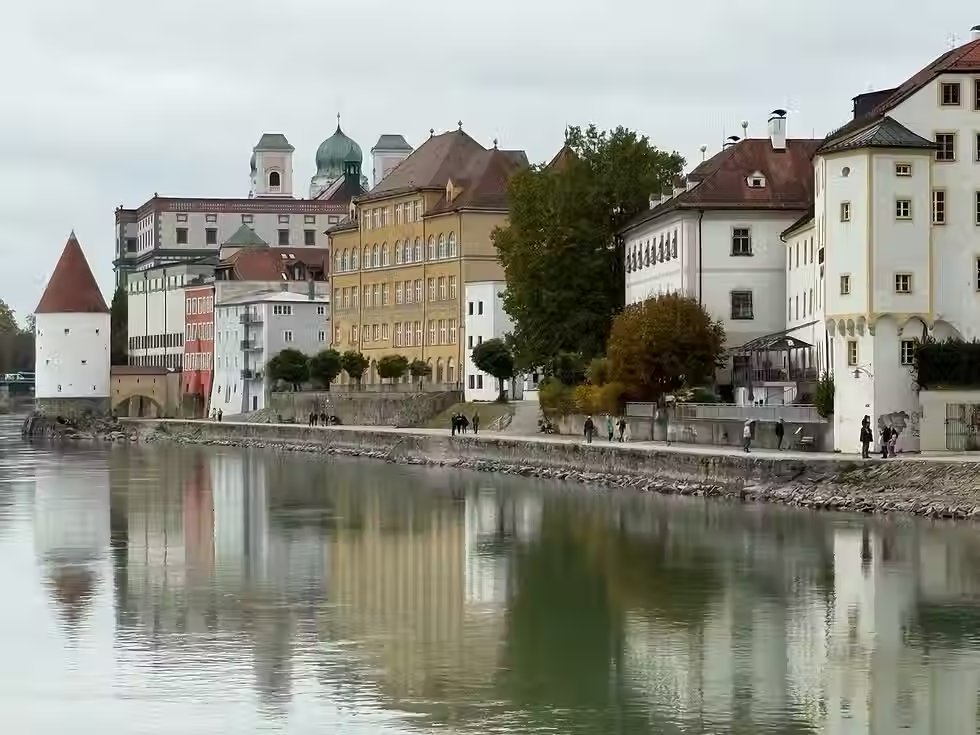
In 2025, Joe and I spent part of our day wandering the back alleys on the Inn side of the Old Town. From the back lanes, join the promenade and walk past the white Schaibling Tower, with the cathedral rising behind the riverfront buildings. Continue west toward the university for a longer riverside walk, or east toward the Dreiflüsseeck.

Innstadt
Neighborhood across the Inn · Innstadt, Passau · Walk across Marienbrücke (map)
Across the Marienbrücke, Innstadt offers neighborhood streets and the view back toward the Old Town. Follow the lower lanes toward Lederergasse before deciding whether to continue to the Roman museum or climb to Mariahilf.
Mariahilf
Pilgrimage church and viewpoint · Mariahilfberg 3, Passau · Steep stairway from Innstadt (map)
The pilgrimage church of Mariahilf stands on the hill above Innstadt. Its covered stairway has more than 300 steps, with another view across the city from the top. This is a substantial climb; choose dry conditions and leave time to return without rushing. The church’s current information helps you plan around services.
The Ilz and Wooded Slopes
Woodland paths and river scenery · Lower Ilz and Oberhauser Leite, Passau · Cross Prinzregent-Luitpold-Brücke; follow a marked walking route (map)
On the northern side of the Danube, the lower Ilz and wooded Oberhauser Leite bring the landscape close to the center. I would like to return for a longer hill walk, perhaps around Klosterberg on the Grubweg side of the city, but I have not hiked it yet. Hillside paths can be narrow and uneven, so use an up-to-date marked route rather than expecting a level riverside stroll.
LOCAL CULTURE
Festivals & Events
Cathedral Music and European Weeks
The cathedral’s organ concert programme is worth checking before a visit. In summer, the Festspiele Europäische Wochen adds concerts and cultural events across Passau and the surrounding border region. Check the venue as carefully as the performance: some events take place well outside the city.

Kunstnacht
During Kunstnacht, galleries, museums and other Old Town spaces open for an evening devoted to art. It suits an overnight visit, with time for dinner and the atmosphere in the lanes rather than a hurried return to the station.
Maidult and Herbstdult
Passau’s spring and autumn Dult fairs combine beer tents, rides and fairground food at the Messepark, away from the historic center. Check the city’s event information for dates and transport. Allow a separate evening or half-day, rather than expecting to find the fair beside the cathedral.
Christkindlmarkt on Domplatz
The cathedral provides the setting for Passau’s Christmas market, with seasonal food and craft stalls through the weeks of Advent. Use the Christkindlmarkt’s current programme for dates and opening hours. Dress for cold, damp evenings and leave room in the day to enjoy the market after dark.
PLAN YOUR TIME
Suggested Itineraries
One full day covers the central walk and the fortress. A second local day gives you time for Innstadt, a museum and a slower river outing. The order below keeps nearby stops together; choose the clearer day for the hilltop views and check seasonal openings before setting out.
ONE DAY
Day 1: Old Town, Three Rivers and Veste Oberhaus
A full city day, starting at the station or your central accommodation. Leave one optional indoor stop for another visit if you arrive late.
Morning
From Passau Hbf, walk through Bahnhofstraße and Ludwigstraße to Domplatz, then visit St. Stephen’s Cathedral. If you want an organ concert, arrange this part of the day around the published programme; the cathedral closes briefly before the noon concert.
Stop at Greindl for chocolates and continue to Residenzplatz. Choose the Museum am Dom if its opening hours fit, or browse Keramikwerkstatt Auer on nearby Milchgasse.
Afternoon
Have lunch nearby, then follow the Inn promenade past Schaibling Tower to the Dreiflüsseeck. Look back upstream for the houses and cathedral rising above the river, then return along the Danube to Rathausplatz.
Take the seasonal shuttle to Veste Oberhaus, or use the steep, signed uphill path if conditions suit. Check current path notices and the last return shuttle before climbing. In rain or poor visibility, substitute the Glasmuseum at Rathausplatz and save the fortress for tomorrow.
Evening
Return to the Old Town for dinner in the lanes between the cathedral and the river.
Take a short riverside walk if the weather is pleasant, or use the evening for a booked concert. Day visitors should allow time to reach their confirmed return bus or train.

Veste Oberhaus above autumn woodland, with a suspension bridge crossing the foreground in Passau.
TWO DAYS
Day 2: Innstadt, Roman Passau and Time on the Water
A quieter second day across the Inn, with one hill or museum and an unhurried afternoon back in the center.
Morning
Cross the Marienbrücke into Innstadt and follow the lower streets toward Lederergasse.
Choose the Roman Museum Kastell Boiotro, normally closed Mondays and for much of winter, or climb the covered steps to Mariahilf in dry weather. If both appeal, keep the rest of the morning free; slippery steps are a reason to stay below.
Afternoon
Have lunch in Innstadt, then return across the bridge. For a longer level walk, continue along the Old Town’s Inn promenade toward the university before turning back.
Take a scheduled 45-minute Three Rivers cruise if boats are operating. In poor weather, choose the MMK Wörlen or another central museum instead; if you deferred the fortress yesterday, use this clearer-weather slot for it.
Evening
Finish with dinner or a café stop around the Old Town, leaving time to collect luggage before departure.
If staying another night, enjoy the riverfront at your own pace. Anyone starting a cycling journey tomorrow can use the remaining time to check bags, the first stage and ferry arrangements.

A hilltop church and monastery buildings in Passau seen through autumn foliage.
BEYOND THE CITY
Nearby Cities & Journeys
Regensburg
About 120 kilometers (75 miles) upstream by road, Regensburg pairs Passau’s Baroque streets with a largely medieval center, the Stone Bridge and a Gothic cathedral. Explore its medieval lanes and riverside sights on a day trip or as the next overnight stop. My Regensburg-to-Passau outing describes the reverse approach. During the rail works through 12 December 2026, check replacement-bus times and ticket validity before committing to a return journey.
Munich
Munich is around 190 kilometers (118 miles) away by road and works better as an onward stay. Its museums, parks and neighborhoods give a larger-city contrast to Passau and deserve time of their own. During the current rail works, the route uses a replacement bus to Plattling and an onward RE 3 train; check the full connection for your date.
The Bavarian Danube by Bicycle
My Regensburg–Passau cycling route covers roughly 150–160 kilometers. I rode it alone over three days in 2018, as part of my longer Ingolstadt–Bratislava trip, passing Straubing, Deggendorf and Vilshofen. Parts were gravel or sandy farm tracks. Allow extra time for town visits and uphill detours to castle ruins.
As I approached Passau in 2018, the open Danube countryside gave way to hills drawing closer to the river. Passing the broad Kachlet barrage and locks felt like arriving at the city. Built in the 1920s, the hydroelectric and navigation works impressed me with their width and the engineering of that period.
Passau to Vienna Along the Danube
The Passau–Vienna ride continues roughly 330 kilometers through Austria. Around six or seven riding days leaves more room for the Schlögener Schlinge, Linz and the Wachau than a distance-led schedule. In September 2018, I usually rode 50–60 kilometers a day and stayed in family-owned Pensionen and small hotels.
I had planned another ride in 2026, either along the Inn from Braunau to Passau or onward from Passau to Linz, but the rail works stopped those plans. Check bicycle transport before committing to a route, as well as ferry crossings and overnight stops. An extra night in Passau lets you enjoy the city before the ride begins.
My Tips for Your Visit
Passau is worth seeing at walking pace. Give the cathedral, riverfronts and one high viewpoint the time they deserve, then leave room for chocolates or a café. One full day works well; an overnight stay leaves time for the opposite bank, an evening event or a relaxed start to a Danube ride. Check the complete outward and return journey during the rail works, especially if you are travelling with a bicycle. For me, Passau marks the transition between the quieter Bavarian Danube and the more dramatic river valley in Austria. Pause here before moving on.
LANDMARKS & SIGHTS
Attractions & Museums
FOOD CULTURE
Food Culture
From the time you arrive in Passau at the Hauptbahnhof, you’ll find restaurants and cafes along the shopping streets all the way to the historic center. From fast food and take away options inside the Stadtgalerie shopping mall, to Bavarian, Italian, Syrian, Indian and Croatian options, there’s a lot of restaurants to choose from due to Passau being a university town and starting and end point for Danube river cruises. One place I remember particularly for their chocolates is Pralinenwerkstatt Greindl, at Domplatz 2 beside St. Stephen’s Cathedral. We went there after visiting the cathedral and residence, and found their chocolates to be outstanding – one was infused with violets, if I remember correctly. If you’re heading to the Veste Oberhaus across the Danube, you may want to consider having a traditional meal at “Das Oberhaus” with a view over the city.
Pralinenwerkstatt Greindl
Chocolate workshop and shop · Domplatz 2, Passau · Beside St. Stephen’s Cathedral (map)

St. Stephen’s Cathedral and Domplatz
Baroque cathedral · Domplatz, Passau · Walk east from Passau Hbf (map)
The cathedral’s pale towers and green domes dominate the Old Town. Inside, the lavish Baroque decoration is a striking contrast to the Gothic cathedral in Regensburg. After the 1662 fire, Italian architects and artists reshaped much of the building, preserving parts of its older eastern end.

Organ concerts continue during the restoration, although only part of the instrument can be played. Noon concerts usually run Monday–Saturday from May through October, excluding public holidays, with selected Advent dates as well. Restoration is currently expected to finish in 2028, and scaffolding may obscure parts of the interior. Check the cathedral concert programme before planning your morning around one.
Residenzplatz and the Prince-Bishops
Historic square and cathedral museum · Residenzplatz; museum at No. 8 · Walk around the cathedral from Domplatz (map)
Walk around the cathedral to Residenzplatz, where the fountain and former episcopal residences reveal the wealth of Passau’s prince-bishops. They were both spiritual leaders and secular rulers, although the lands they governed were much smaller than their diocese. Their ecclesiastical influence once extended to Vienna, which became a separate diocese in 1469. The Museum am Dom adds sacred art and treasures if you want to explore this history indoors.
Dreiflüsseeck and the Riverfronts
Three-river confluence · Ortspitze, Passau · Walk east along the Inn or Danube promenade (map)
Follow the Inn side of the peninsula toward the Dreiflüsseeck, where the Inn, Danube and Ilz meet. Their contrasting colors depend on the light and water conditions. My favorite view is back upstream along the Inn: the city rises steeply from the riverbank, with the cathedral and its domes above the houses. Return along the Danube for the town hall frontage, moored boats and the two fortresses.

Veste Oberhaus
Fortress, museum and viewpoints · Oberhaus 125, Passau · Seasonal shuttle from Rathausplatz; steep walk via Ludwigsteig (map)
Veste Oberhaus was the prince-bishops’ stronghold. From above, I enjoy picking out the towers, spires and domes across the narrow Old Town peninsula. Its courtyards and city-history museum make the ascent more than a photo stop. Museum admission includes the Batterie Linde three-river viewpoint and observation tower when open.
The Ludwigsteig starts across the Prinzregent-Luitpold-Brücke and involves a steep climb with steps. The seasonal shuttle from Rathausplatz runs from mid-March to mid-November, with departures roughly every half hour. Check the shuttle timetable and museum access information before setting out, and follow current path signs. The tower has a shorter season than the museum and closes in severe weather.

Museum Moderner Kunst Wörlen
Modern and contemporary art · Bräugasse 17, Passau · Walk east from Rathausplatz (map)
The Museum Moderner Kunst Wörlen on Bräugasse is the choice for modern and contemporary art. Its changing exhibitions offer an indoor stop near the eastern end of the Old Town.
Glasmuseum Passau
Glass museum · Schrottgasse 2, Passau · At Rathausplatz (map)
The Glasmuseum beside Rathausplatz explores European glass and decorative styles. It fits easily between a riverside walk and the fortress shuttle, or as an alternative when the hilltop view is hidden by rain.
Roman Museum Kastell Boiotro
Roman archaeology museum · Lederergasse 43–45, Passau · Bus 3/4 to Jahnstraße, then walk; or via Marienbrücke (map)
The Roman Museum Kastell Boiotro is built around the remains of a late Roman fort. It shows a much earlier chapter of Passau’s history than the Baroque streets across the river. The usual season is March to mid-November, Tuesday–Sunday, with selected Christmas openings. Check the museum’s visitor information before crossing over for a visit.
Three Rivers Cruise
Sightseeing boat trip · Danube landings on Fritz-Schäffer-Promenade · Walk from Rathausplatz; confirm your pier (map)
Joe and I took a riverboat tour during our 2025 visit, after walking the Old Town’s Inn-side lanes. Seeing the waterfront from the water adds another perspective on the city. For a short outing, Wurm & Noé’s Three Rivers sightseeing cruise takes about 45 minutes. Check the current sailing and departure pier; longer Danube trips need more of the day, and river levels can affect the programme.

Traditional Food
Passau’s menus reflect its Bavarian setting and proximity to Austria, with roast dishes, cheese, pastries and local beer all having a place. My personal recommendation is the chocolate stop above; the other selections are regional foods and drinks to look for around town. Together they allow for both a substantial meal and a smaller break.

Handmade chocolates and truffles from a Passau favorite.
Pralines
Handmade filled chocolates and truffles are the specialty at Pralinenwerkstatt Greindl beside Passau’s cathedral. I particularly recommend this stop. The fillings and chocolate coatings offer different flavors and textures, making these small sweets distinct from a slice of café cake.

Bavarian roast pork makes a substantial meal.
Schweinsbraten
Schweinsbraten is Bavarian roast pork, commonly served with gravy and dumplings. The cut and preparation vary, with the sauce and accompaniments forming an important part of the meal. It belongs to wider Bavarian cooking rather than being unique to Passau.

Soft egg noodles meet cheese and onions.
Käsespätzle
Käsespätzle combines soft egg noodles with cheese, often finished with onions. The cheese melts through the noodles to make a rich, filling dish, while the onions add another texture and flavor. It is a regional alternative to roast meat, though ingredients vary between kitchens.

Seasoned cheese spread is a Bavarian Brotzeit option.
Obatzda
Obatzda is a seasoned cheese spread eaten with bread or a pretzel as part of a Bavarian Brotzeit. Its soft texture makes it a spread rather than a slice of cheese. The strength of the cheese and seasoning varies with the recipe.

Apple strudel reflects the overlap with Austrian cooking.
Apfelstrudel
Apfelstrudel is thin pastry wrapped around an apple filling. The baked fruit and layers of pastry provide contrasting textures, distinguishing it from an apple cake. It reflects the overlap between Bavarian and Austrian food traditions around Passau.

Local breweries add a Passau connection to the drinks menu.
Local beer
Passau has a local brewing tradition represented by names such as Hacklberg and Löwenbrauerei. Each brewery offers particular beer styles, so a brewery name alone does not describe the flavor. These drinks form part of the city’s Bavarian food culture alongside its traditional meals.
THROUGH THE YEAR
When to Visit
Explore the guides below for practical tips, things to see and do, local food, events and ideas for trips beyond your destination.
SPRING
Spring (March–May)
Spring starts chilly and becomes mild, but rainfall rises markedly toward May.
Climate: Average daytime highs 9–19°C (48–66°F); overnight lows 1–9°C (34–48°F). Showers are possible, with wetter weather toward May.
Seasonal highlight: The Maidult brings Bavarian fairground traditions in late April and early May.
Outdoors and clothing: Wear layers and a rain-resistant jacket, with grippy shoes for cobbles and the paths toward Veste Oberhaus.
Add paragraph text. Click “Edit Text” to update the font, size and more. To change and reuse text themes, go to Site Styles.
SUMMER
Summer (June–August)
Summer is warm with cooler evenings, and it is also Passau’s wettest season.
Climate: Average daytime highs 22–24°C (72–75°F); overnight lows 12–14°C (54–57°F). Warm spells and summer showers call for flexible outdoor plans.
Seasonal highlight: The Festspiele Europäische Wochen brings concerts and cultural events to Passau and the surrounding region in June and July.
Outdoors and clothing: Pack light clothes, a rain shell and a layer for cooler evenings. Carry water and sun protection for the uphill walk to Veste Oberhaus.
Add paragraph text. Click “Edit Text” to update the font, size and more. To change and reuse text themes, go to Site Styles.
FALL
Fall (September–November)
Early autumn remains mild, followed by much cooler days and chilly nights toward November.
Climate: Average daytime highs 6–19°C (43–66°F); overnight lows 1–10°C (34–50°F). Fog and damp mornings become more likely as the season cools.
Seasonal highlight: Passau’s Herbstdult brings beer tents, Bavarian food and fairground rides in September.
Outdoors and clothing: Add a warm layer for the riverbanks and shoes with traction for damp steps. A compact umbrella is useful around the Old Town.
WINTER
Winter (December–February)
Winter is cold, with frequent freezing nights and precipitation that can fall as snow.
Climate: Average daytime highs 1–4°C (34–39°F); overnight lows −4 to −2°C (25–28°F). Rain, snow and icy patches can affect riverfront walks.
Seasonal highlight: The Christkindlmarkt sets seasonal stalls beside St. Stephen’s Cathedral from late November through December.
Outdoors and clothing: Bring an insulated coat, scarf, gloves and grippy footwear. Avoid steep paths when ice makes them slippery.
Add paragraph text. Click “Edit Text” to update the font, size and more. To change and reuse text themes, go to Site Styles.
On my September Danube ride, cool and sometimes foggy mornings gave way to warmer afternoons. Bring a layer rather than judging the whole day by the temperature at breakfast. Check seasonal museums and boats before building a full itinerary.