
Vienna to Bratislava
A compact capital of castle views, cobbled streets and Danube connections
OVERVIEW
Why Make this Journey
Bratislava feels much smaller and less monumental than Vienna, but that is precisely what makes it work so well as a separate trip. The historic center rises gently away from the Danube, with narrow streets, churches and small squares below the more prominent climb to Bratislava Castle. I arrived by bicycle in 2018 after following the Danube east starting in Ingolstadt and eventually passing through Vienna, and stayed for two nights before taking the fast catamaran back. I walked through the Old Town, saw the Old Town Hall and several churches, and climbed to the castle for the views over the river. I no longer remember every building I entered or where I ate, but I remember the city as manageable, pleasant and easy to explore without a complicated plan. Bratislava can be visited in a day, although staying overnight gives you time to enjoy the center after many of the day visitors have returned to Vienna.
If you're planning time in Bratislava, browse Bratislava experiences on Klook via this paid link.

Illustrated travel routes from Vienna to Bratislava by train, car, bicycle and Danube ferry
EXPLORE
Places & Experiences

Follow the Danube into Slovakia
Bratislava is close enough to Vienna to visit for a day, but the journey feels more significant than the short distance suggests. You cross an international border, enter Slovakia and arrive in a capital with a noticeably different scale and character. Vienna is expansive and monumental; Bratislava feels more compact, less formal and easier to understand within a few hours.
I reached Bratislava by bicycle in 2018 as the final stage of a longer Danube ride that had begun in Ingolstadt. After spending time in Vienna, I continued east through the city’s Danube recreation areas and into the flatter landscapes beyond it. Along the route, I saw the Danube, long cycling paths, bridges, agricultural land, Hainburg’s historic center and eventually the first distant views of Bratislava.
The ride was not difficult because of hills, but it was a substantial cycling day. Distance, wind and summer heat matter more here than elevation. I stayed in Bratislava for two nights rather than trying to explore the city immediately and return on the same day.
Approach Bratislava Along the River
One of the most memorable parts of arriving is seeing how clearly Bratislava’s geography reveals itself. Bratislava Castle rises above the northern bank of the Danube, while the SNP Bridge and its distinctive UFO observation tower extend across the river toward Petržalka.
The contrast is striking. On one side is the historic castle and compact Old Town; on the other are the bridge, modern development and large residential districts. The Danube divides these parts of Bratislava but also ties the city together visually.
Visitors arriving by fast ferry receive a similar introduction from the water. The boat docks close to the historic center, making it possible to begin exploring almost immediately. Train passengers arrive farther from the river but can reach the center easily by public transportation or on foot.
Explore the Historic Center
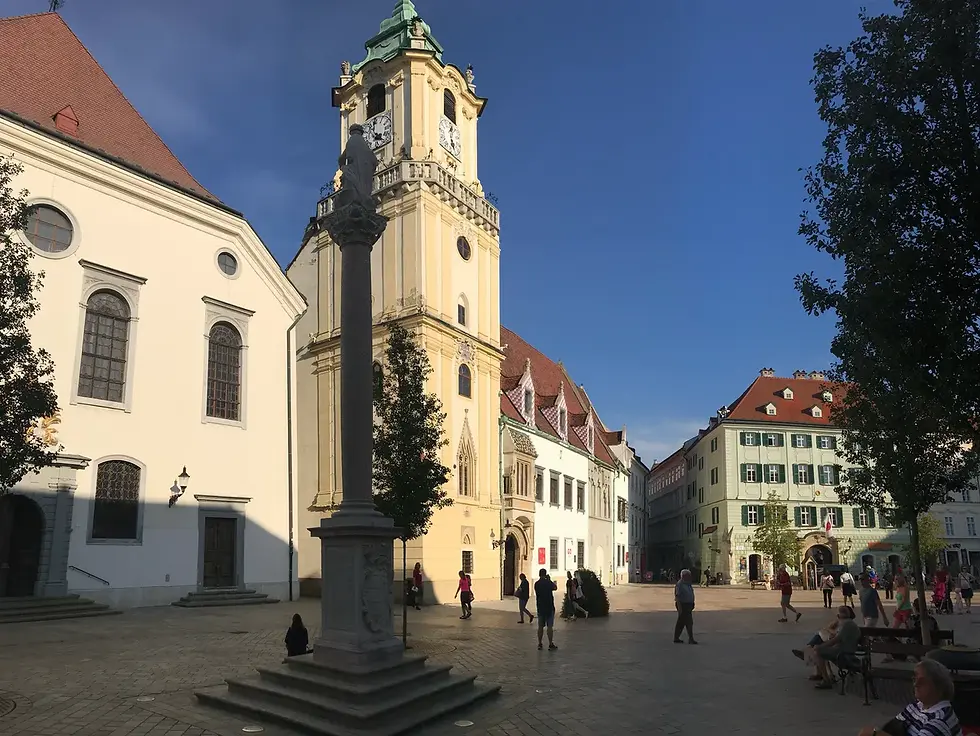
Bratislava’s Old Town is small enough to explore without an elaborate itinerary. I wandered through its pedestrian streets, saw the Old Town Hall, entered several churches and spent time around its squares. What stays with me is the combination of narrow lanes, pastel-colored façades, towers and public spaces.
Main Square is a useful point of orientation. The Old Town Hall developed from several historic buildings and now houses the Bratislava City Museum. Its tower rises above the surrounding roofs and provides one of the central landmarks within the Old Town.
From the square, continue through the surrounding streets toward Michael’s Gate, the only surviving gate from Bratislava’s medieval fortifications. The tower appears above one of the most recognizable approaches into the historic center. This part of Bratislava is compact and heavily visited, but the smaller side streets quickly become quieter.
The Primate’s Palace and several churches add architectural variety. St. Martin’s Cathedral is particularly important historically because it served as the coronation church for Hungarian kings and queens from 1563 to 1830, during the period when Bratislava was one of the most important cities in the Kingdom of Hungary.
This history helps explain why Bratislava contains more than might be expected from its present size. The city has been known by several names, including Pressburg in German and Pozsony in Hungarian, reflecting its position between different languages, cultures and political powers.
Walk Up to Bratislava Castle
Bratislava Castle is the city’s defining landmark and should be included even during a shorter visit. The Old Town rises gradually away from the river, but the final approach to the castle is a more noticeable climb.
The castle stands approximately 80 meters above the Danube. Its broad white walls and four corner towers make it visible from many parts of the city and from boats traveling along the river. The present appearance is largely the result of twentieth-century reconstruction after a major fire destroyed the castle in 1811.
I walked up from the center and spent time around the castle and its viewpoints. Even without visiting the Historical Museum inside, the grounds provide a clearer understanding of Bratislava’s setting. From above, you can look across the Old Town rooftops, the Danube, the SNP Bridge and the residential districts beyond it.
The castle’s reconstructed Baroque Garden provides a more formal contrast to the fortress-like exterior. If time is limited, I would prioritize the grounds, garden and views rather than trying to add a lengthy museum visit.
Allow Time to Wander
Bratislava does not require the same intensive sightseeing plan as Vienna. Its center is small, and much of the experience comes from walking between the principal landmarks rather than spending hours inside individual attractions.
I stayed for two nights, which meant I did not have to turn the city into a checklist. I could walk through the center, climb to the castle, look inside churches and return to the river without continually checking a departure time.
For a day trip, choose a café or restaurant that looks appealing and use the meal as a break between the Old Town and castle.
Return to the Danube
After visiting the castle, descend toward St. Martin’s Cathedral and the riverfront. This completes a natural loop through the center and returns you to the relationship between the Old Town, castle and Danube.
The UFO observation deck is visible throughout this part of the walk. I photographed the bridge and tower but do not specifically remember visiting the observation deck. It can provide another elevated view, although the castle already offers excellent views without crossing the river.
If you have additional time, continue east along the riverfront. If you are visiting only for the day, it is better to preserve time for the historic center and castle than to add too many outlying attractions.
Return to Vienna by Fast Ferry
I returned to Vienna with my bicycle aboard the fast catamaran. This was one of the strongest parts of the entire journey. I had followed the Danube landscape by bicycle and could now see it again from the water.
Leaving Bratislava provides open views of the castle and UFO bridge. Farther along the route, the boat passes the area around Devín Castle, where the Morava River meets the Danube. The castle ruins stand high above the water and were clearly visible during my journey. The route then continues past the landscapes between Bratislava, Hainburg and Vienna.
Bicycle spaces on the ferry are limited, so I had to travel on a service that could accommodate the bike. Anyone repeating this journey should reserve the bicycle space at the same time as the passenger ticket.
The boat eventually enters Vienna along the Danube Canal and arrives near Schwedenplatz. After spending much of the journey in open river landscapes, the return to Vienna’s dense urban center feels surprisingly dramatic.
Make It a Day Trip or Stay Overnight
Bratislava works as a full-day trip because the central sights are close together. A practical day begins near the river, continues through the Old Town, climbs to the castle and finishes back along the Danube. This covers the parts of Bratislava that made the greatest impression on me.
An overnight stay changes the pace. The center becomes quieter after many day visitors leave, and there is no need to shorten the castle visit to catch a particular boat or train. I stayed for two nights because Bratislava was the conclusion of my cycling journey. For a conventional visit from Vienna, one night would usually provide enough additional time.
Bratislava's appeal lies in its different scale, history and atmosphere. It offers another national capital, a different cultural and historical setting and one of the most varied transportation choices of any trip from Vienna. You can travel by train, car, bicycle or fast ferry, and combining two of those options makes the journey especially worthwhile.

Grassalkovich Palace with Slovak and European Union flags in Bratislava
Journey at a Glance
Starting point: Vienna
Destination: Bratislava, Slovakia
Train journey: Approximately one hour
Fast ferry: Seasonal service between central Vienna and Bratislava’s riverfront
Cycling: A substantial full-day ride through the Danube corridor
Recommended visit: One full day or one night
My journey: Bicycle from Vienna, two nights in Bratislava and fast ferry back with my bicycle
Main experiences: Historic center, Old Town Hall, churches, Bratislava Castle, Danube riverfront and views of the UFO bridge
Walking conditions: Compact center with cobblestones and a noticeable climb to the castle
Getting There by Train
Regional express trains connect Vienna with Bratislava in approximately one hour. Services use Bratislava hlavná stanica or Bratislava-Petržalka, depending on the route. Neither station is directly within the historic center, but public transportation connects both with the Old Town.
The train provides the greatest flexibility and is the easiest choice when ferry schedules do not fit the day. ÖBB also offers a Bratislava Ticket that combines the cross-border rail journey with Bratislava public transportation on the first day of validity. Check current connections and ticket conditions directly before traveling.
Getting There by Fast Ferry
The Twin City Liner travels between Schwedenplatz in Vienna and the Bratislava riverfront. Its Bratislava landing point is close to the Old Town, which makes the ferry particularly convenient for sightseeing.
The service is seasonal and operates less frequently than the train. Reserve in advance, especially on weekends or when traveling with a bicycle. Boarding begins before departure, and passengers should carry a valid passport or national identity document.
For a day trip, taking the ferry to Bratislava and returning by train combines the river journey with a more flexible return. My own journey worked in the opposite direction because I cycled to Bratislava and used the ferry to return to Vienna.
Cycling from Vienna
Treat the bicycle route as a journey of its own, not simply as transportation before a full sightseeing day. The route follows the Danube corridor east from Vienna and passes through open landscapes and Hainburg before entering Slovakia.
Although the terrain is mostly flat, distance, wind, sun and heat can make the ride demanding. Carry enough water, use current cycling navigation and allow time for stops. Staying overnight in Bratislava is the most practical approach.
Reserve bicycle transportation on the return ferry before beginning the ride. Bicycle capacity is limited, and not every type of bicycle or trailer can be carried.
Suggested Day-Trip Sequence
Arrive at the riverfront or travel from the station into the center.
Walk toward St. Martin’s Cathedral.
Continue through the Old Town to Main Square and the Old Town Hall.
Explore the surrounding streets and Michael’s Gate.
Stop for lunch or a café break.
Walk up to Bratislava Castle.
Explore the grounds, garden and viewpoints.
Descend toward the Danube and return by train or ferry.
This route stays within the center and leaves time for a meal and the castle climb.
Day Trip or Overnight Stay
A full day is sufficient for the Old Town, castle and riverfront. One overnight stay creates more time for an evening meal, quieter streets and a slower castle visit.
Two nights make sense for cyclists, museum visits or an additional excursion to Devín Castle. Devín should be treated as a separate extension rather than squeezed into the central Bratislava itinerary.
Practical Considerations
Carry identification for the international journey.
Check train and ferry schedules shortly before departure.
Reserve the fast ferry and any bicycle space in advance.
Wear comfortable shoes for cobblestones and the castle climb.
Bring water during warm weather, especially when cycling.
Confirm museum and church hours if interior visits are important.
Avoid overplanning. The compact center is best experienced with time to wander.

River cruise ship moored on the Danube below Bratislava Castle