

Frankfurt to Bonn
Discover Beethoven’s hometown, riverside walks and the history of modern Germany.
OVERVIEW
Why Make this Journey
Bonn left me with a very positive impression: a beautiful city in a lovely setting, with friendly people who made it feel welcoming. On the Rhine, Germany’s former capital brings together a walkable center, Beethoven’s birthplace and museums that help explain the country’s recent past. Around the market square, the pale pink Old Town Hall provides an elegant backdrop to cafés and everyday city life, while the river offers space to slow down and watch the boats pass.
From Frankfurt, Bonn works as a full-day outing via ICE train, but I would allow an overnight stay if you enjoy museums and unhurried exploring. You can spend one day around the historic center and Rhine, then use the next morning for the Museum Mile or a walk through the handsome residential streets of the Südstadt. Its appeal is the combination: music, political history, riverside scenery and a university city that feels lived in. Leave room for a café stop and a proper lunch alongside the sightseeing.
To compare places to stay, browse Bonn hotels on Klook via this paid link.
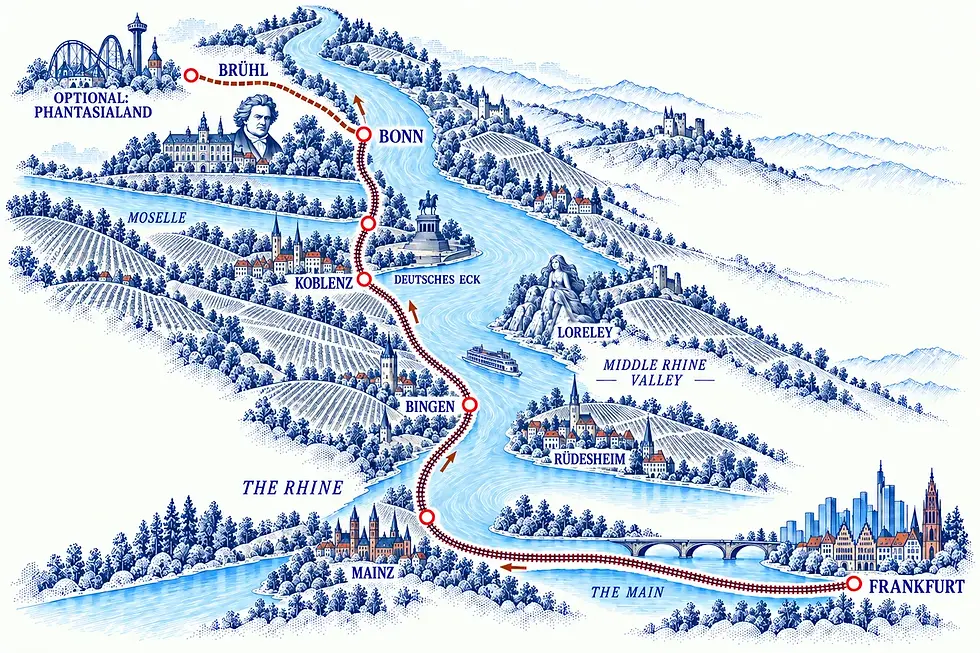
Illustrated Rhine journey map showing the route from Mainz through Rüdesheim, Bingen, Koblenz and Bonn to Brühl.
EXPLORE
Places & Experiences

Start around Münsterplatz and the market square
From Bonn Hauptbahnhof, walk into the center and begin at Münsterplatz, where the Beethoven monument stands near Bonn Minster. Continue through the pedestrian streets to the market square and the Old Town Hall, with its decorative façade and sweeping staircase. These closely spaced sights make an easy introduction to the city. Allow about an hour, longer if you stop for breakfast or go inside the church.
Visit Beethoven’s birthplace
Continue to Bonngasse and the Beethoven-Haus, where the composer was born in 1770. The museum offers a closer look at his life through original objects, documents and musical exhibits. Allow roughly 60–90 minutes if you are interested in music. If a museum visit does not appeal, you can see the house from the street and spend more time exploring the surrounding center.
Make time for a local lunch
When the market is open, the square in front of the Old Town Hall is a good place to browse and pick up something for lunch. Alongside fresh produce, you’ll find food stalls offering a casual alternative to a restaurant meal. Or stop at a local butcher for a warm snack, pick up a bun or pastry from a bakery or grab a döner. On a nice day, take your lunch down to the Rhine and find somewhere to sit by the water. If you prefer a sit-down meal, Brauhaus Bönnsch near the center is a good option for hearty food and its own locally brewed beer. It fits nicely into a leisurely lunch break before continuing your walk through Bonn.
Walk down to the Rhine
After lunch, head toward the river for a change of pace. Follow the promenade south from the area around Kennedybrücke, with boats passing on the Rhine and views across to Beuel. Allow 30–60 minutes for an easy walk and a stop by the water.
For a first visit, this is a good place to keep the afternoon flexible. Return toward the university’s former electoral palace and Hofgarten for more central sightseeing, or continue with a museum visit if modern German history interests you.
Choose one substantial museum visit
The Haus der Geschichte on the Museum Mile explores Germany since 1945. It gives context to the country’s division, everyday life in East and West Germany, and reunification. Allow about two hours, or longer if you enjoy reading the exhibits. Admission is free, and the museum is normally closed on Mondays. Use public transport to reach the Museum Mile if you want to save walking time.
Art lovers could instead choose the Kunstmuseum Bonn, particularly for August Macke, the Rhenish Expressionists and German art after 1945. For a day trip, choose the museum that interests you most rather than squeezing several into the afternoon.
With an overnight stay
Spread the center and museums across two days, leaving time for dinner and an evening walk. The Südstadt offers handsome residential streets for an unhurried wander. In spring, consider a separate detour north of the center to Heerstraße and Breite Straße, the best-known streets for Bonn’s cherry blossoms. This neighborhood, commonly called the Altstadt, is distinct from the central sightseeing area around the market square.
A Personal Favorite: Phantasialand
Phantasialand in nearby Brühl has been a favorite of mine since I first visited at around ten years old. I returned as a teenager with friends during a camping trip, and those visits remain fond memories. For me, it is one of Europe’s best theme parks, particularly because of the imagination and attention to detail that go into its attractions and themed surroundings.
Give it a full day of its own. It makes a fun addition to a stay in Bonn, especially if you enjoy roller coasters and beautifully designed attractions. A little piece of theme park history: Michael Jackson officially inaugurated the Colorado Adventure mine train coaster in 1996.

Beethoven Monument on Münsterplatz with the towers of Bonn Minster rising behind it.
Planning Your Bonn Trip
Allow a full day for a first look, or stay two to three nights. A day gives you time for the center, a Rhine walk and one museum. A longer stay lets you explore Bonn’s neighborhoods and museums while including a trip into the surrounding area.
You generally don’t need a car. Bonn’s center is walkable, with public transport connecting the railway station, Museum Mile and other neighborhoods.
Check which station your train serves. Fast journeys often use Siegburg/Bonn, followed by local transport into central Bonn. Allow around 1½–2 hours overall, depending on the connection.
Consider the Rhine Valley route for one direction. Trains routed through Mainz and Koblenz offer riverside scenery but take longer than the high-speed route. Check the complete journey before booking.
Choose one main museum for a day trip. Beethoven-Haus suits music enthusiasts, while the Haus der Geschichte focuses on Germany since 1945. Trying to see both can leave little time for the city itself.
Check museum opening days. The Haus der Geschichte normally closes on Mondays. Confirm opening hours for your chosen attractions before deciding when to travel.
Use Bonn as a base for a varied short break. Combine a day of city sightseeing with a day at Phantasialand, then leave additional time for museums, riverside walks and exploring the region.
Give Phantasialand its own day. The theme park in nearby Brühl is a worthwhile addition for families and theme park enthusiasts. Check opening dates, tickets and your complete journey before setting out.
Compare rail fares in advance. Train tickets can be the largest expense. The city center and riverside are free to explore, and admission to the Haus der Geschichte is free.
Check seasonal highlights before booking. Cherry blossoms usually appear in April, Rhein in Flammen takes place around the first weekend in May, and Beethovenfest runs around September. The Christmas market adds atmosphere in November and December.
Keep part of the afternoon flexible. Good weather may make a longer Rhine walk more appealing, while a rainy day is a good opportunity to spend more time in a museum.
Is Bonn the right trip for me?
Best for: Music, modern German history, museums and riverside walks.
For a first visit: The historic center, Beethoven-Haus and a walk along the Rhine.
For history enthusiasts: The Haus der Geschichte and former government quarter.
For a slower pace: Spread the museums, neighborhoods and Rhine walks across several days, with time for cafés and relaxed meals.
For a lower-cost visit: A city walk, the Rhine promenade and the free Haus der Geschichte, with rail tickets booked ahead.
For families and theme park enthusiasts: Add a full day at Phantasialand in nearby Brühl.
For a longer stay: Two to three nights combining Bonn’s sights with time in the surrounding area.
Rhine & Moselle Cruise Guide
To add a boat trip, read our Rhine & Moselle River Cruises and Sightseeing Boats feature. It explains cruises from Bonn toward Königswinter and Linz, how this stretch differs from the Rhine Gorge, and options for a longer river journey.

Pedestrian square beside Bonn Minster, with historic buildings, shops and a church tower in the distance.