

Vienna Food
From Wiener Schnitzel and coffeehouse cakes to Würstelstände and international restaurants, Vienna offers plenty of ways to eat well.
FOOD CULTURE
A Taste of the City
Vienna is one of those cities where food traditions are woven into everyday life. You can have Wiener Schnitzel in an elegant restaurant, stand outside a Würstelstand for a quick sausage, linger over coffee and cake in a grand café or find restaurants representing cuisines from around the world. The city's famous coffeehouse culture is particularly enjoyable because the surroundings are often part of the experience, with historic interiors, formal service and display cases filled with cakes and pastries. I've tried the famous Sachertorte at Hotel Sacher as well as the Imperial Torte at Hotel Imperial, but I also enjoy simply stopping somewhere for coffee and whatever cake looks good that day. On my most recent visit, that included coffee and cake at Café Mozart before visiting the Albertina. Vienna has its celebrated culinary institutions, but you don't need to turn every meal into an event to enjoy its food culture.

Viennese coffee topped with whipped cream and a wafer, served in a traditional café.
Some of my strongest Vienna food memories are much less formal. When I first visited as a young teenager, I remember eating lángos at the Prater covered with an enormous amount of garlic, then continuing to ride roller coasters and other attractions, perhaps not the wisest combination. Decades later, I still like mixing traditional food with whatever fits the day. On my latest visit we had Wiener Schnitzel at Meissl & Schadn, ate Italian food while exploring Spittelberg and passed countless Würstelstände while walking through the center. Vienna's Christmas markets add another layer, with hot drinks, sausages, pastries and other seasonal foods becoming part of a winter evening. Even the vocabulary can be distinctly Viennese. Tomatoes become Paradeiser, whipped cream is Schlagobers, and familiar foods sometimes arrive under names that differ from those commonly used in Germany. For me, that mix of grand culinary traditions, casual street food and an increasingly international restaurant scene is what makes eating in Vienna interesting.
TRADITIONAL FOODS
Local Specialties to Try
Viennese cuisine has a remarkably strong identity, shaped by the former Habsburg Empire and influences from across Central and Eastern Europe. Its best-known dishes range from Wiener Schnitzel and sausages to dumplings, stews and an extraordinary collection of cakes, pastries and sweet dishes. Some foods associated with Vienna have roots elsewhere in the former empire but became firmly embedded in the city's culinary traditions over generations. Coffeehouse culture is equally important, turning cakes and desserts into something to sit down and enjoy rather than simply take away. At the other end of the spectrum are Würstelstände, markets and seasonal fairs where some of the city's most satisfying foods are eaten standing up. The nine traditional foods below offer a cross-section of these different sides of Vienna, from hearty savory dishes to the sweets for which the city is especially famous.
Wiener Schnitzel
Wiener Schnitzel is made from veal, pounded thin, coated in flour, egg and breadcrumbs, then fried until the breading is crisp, golden and slightly puffed. It is usually served simply with lemon and often accompanied by potato salad or parsley potatoes. Pork versions are also common, usually identified as Schnitzel Wiener Art or Schweinsschnitzel.
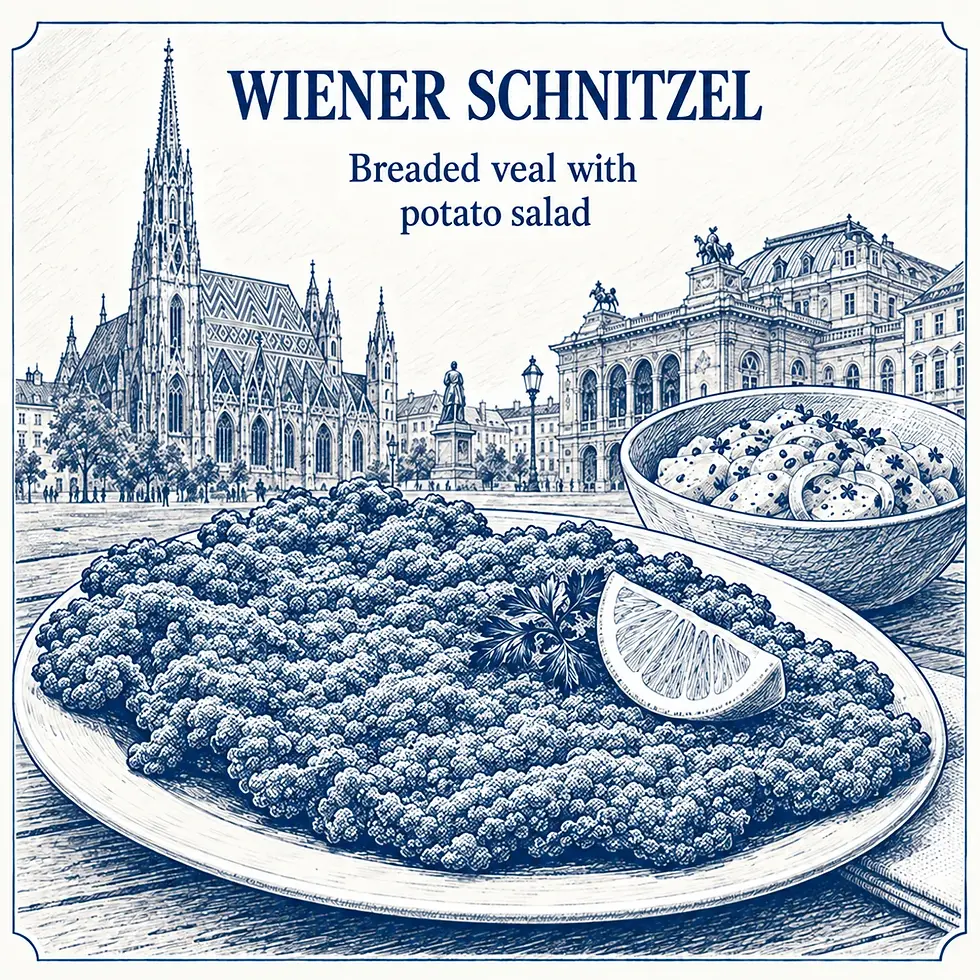
Golden Wiener Schnitzel served with lemon and traditional Austrian potato salad.
Tafelspitz
Tafelspitz is boiled beef gently cooked with root vegetables and spices until tender, then traditionally served with some of its broth and a selection of accompaniments. These may include horseradish, chive sauce, potatoes and creamed spinach. It is a classic example of Vienna’s more refined traditional cooking.

Traditional Viennese Tafelspitz with tender boiled beef, vegetables and classic accompaniments.
Topfenpalatschinken
These thin Austrian pancakes are filled with sweetened Topfen, the Austrian term for quark, a fresh curd cheese, before being rolled and often baked with a creamy sauce. Soft, lightly sweet and comforting, Topfenpalatschinken demonstrate Vienna’s fondness for dishes that comfortably blur the line between dessert and a meal.

Viennese Topfenpalatschinken filled with sweet curd cheese and baked until golden.
Sachertorte
Created in Vienna in the 19th century, Sachertorte is a dense chocolate cake layered with apricot jam and covered in dark chocolate glaze. It is traditionally served with unsweetened whipped cream. You can try the famous version at Hotel Sacher, although countless Viennese cafés and pastry shops offer their own interpretations.

Slice of Viennese Sachertorte with chocolate glaze and whipped cream.
Kaiserschmarrn
Kaiserschmarrn is a thick, fluffy pancake torn into bite-sized pieces while cooking, lightly caramelized and dusted with powdered sugar. Raisins are frequently added, and it is commonly served with a fruit compote or plum sauce. Filling enough to be a meal, it is one of Austria’s most enjoyable sweet dishes.

Fluffy Austrian Kaiserschmarrn with powdered sugar and fruit compote.
Apfelstrudel
Viennese Apfelstrudel wraps thin pastry around a filling of sliced apples, sugar, cinnamon and often raisins and breadcrumbs. Served warm or at room temperature, sometimes with whipped cream or vanilla sauce, it is a coffeehouse classic and one of the easiest traditional desserts to find throughout Vienna.

Traditional Viennese apple strudel filled with apples, cinnamon and raisins.
Zwiebelrostbraten
Zwiebelrostbraten combines a pan-fried or braised slice of beef with a rich savory sauce and a generous topping of crispy fried onions. Depending on the restaurant, it may be accompanied by potatoes, dumplings or other traditional sides. It is hearty Austrian comfort food and particularly satisfying in cooler weather.

Viennese Zwiebelrostbraten with beef, savory gravy and crispy fried onions.
Fiakergulasch
Vienna puts its own spin on goulash with Fiakergulasch, named after the city’s traditional horse-drawn carriage drivers. Rich beef goulash is typically accompanied by a sausage, fried egg, pickle and bread dumpling. It is substantial, flavorful and reflects the Central European influences that helped shape Viennese cooking.

Viennese Fiakergulasch with beef goulash, sausage, fried egg, pickle and dumpling.
Käsekrainer
A favorite at Vienna’s Würstelstände, Käsekrainer is a smoked sausage containing small pieces of cheese that melt as it cooks. It can be served sliced on a plate or tucked into bread with mustard and other condiments. It is casual, filling and one of the quintessential foods to try from a Viennese sausage stand.

Grilled Viennese Käsekrainer sausage filled with melted cheese and served with mustard.