
Osaka Travel Tips
Plan your arrival, explore the city and choose the season that suits you
OVERVIEW
Before You Go
Osaka is easy to explore with a combination of trains, buses, walking and the occasional taxi. Its main sightseeing areas are spread out, so choose a hotel with useful transport connections and group your day around nearby places. River cruises offer another way to see the city while giving your feet a rest.
We stayed four nights at the RIHGA Royal Hotel on Nakanoshima and used different transport depending on the outing. If you book through this link, I may earn a small commission. A little preparation helped most with airport transfers, the enormous station complexes and understanding which journeys our tickets covered.
THROUGH THE YEAR
When to Visit
Spring and autumn suit walking around Osaka, but the start and end of each season feel very different. March evenings can be chilly, September still feels like summer, and our October stay was hot. Choose dates for the weather you enjoy as well as blossoms, festivals or autumn color. The temperatures below span average monthly lows and highs within each season.
SPRING
March–May
March starts cool, while May can feel pleasantly warm. Blossom season and the Golden Week holidays bring stronger demand for accommodation.
Climate: Average daytime highs 14–25°C (58–77°F); overnight lows 6–16°C (43–61°F). Rain is possible throughout the season.
Seasonal highlight: Cherry blossoms brighten Osaka Castle Park and the Okawa riverside; the timing varies each year.
Outdoors and clothing: Wear layers, with a sweater and jacket for March, lighter tops for May and a compact umbrella.
Blossoms, warming days and busy holiday periods.
SUMMER
June–August
Summer brings humid heat, warm nights and lively festivals. Plan shorter outdoor walks with breaks indoors.
Climate: Average daytime highs 28–34°C (82–93°F); overnight lows 20–26°C (69–78°F). The early-summer rainy season gives way to stronger heat.
Seasonal highlight: Tenjin Matsuri brings processions and river celebrations in July.
Outdoors and clothing: Pack loose, breathable clothing, a sunhat and quick-drying footwear. Carry water, and keep a light layer for air-conditioning. Typhoons can disrupt outdoor plans.
Festival evenings, humid heat and indoor breaks.
FALL
September–November
September often still feels like summer, while November is much better suited to long walks. Our October stay was hot.
Climate: Average daytime highs 18–30°C (64–85°F); overnight lows 10–22°C (50–71°F). Autumn rain fronts and typhoons can affect travel.
Seasonal highlight: Later autumn brings color to the parks and more comfortable walks through Osaka’s smaller neighborhoods.
Outdoors and clothing: Begin with lightweight clothes for September; add long sleeves, a sweater and a jacket for November evenings. Check the forecast before packing.
Warm early autumn, cooler walks and late-season color.
WINTER
December–February
Winter is comparatively dry, with cool days and colder evenings. Food halls, museums and shopping streets fit naturally between outdoor stops.
Climate: Average daytime highs 10–12°C (49–54°F); overnight lows 3–5°C (37–42°F). Exposed riverfront walks can feel colder.
Seasonal highlight: Midosuji and Nakanoshima’s seasonal illuminations brighten the evenings. Check individual attraction openings around New Year.
Outdoors and clothing: Bring a warm coat, sweater, long trousers and closed shoes; a scarf and gloves help beside the river.
Illuminated streets, museums and cold evenings.

Cherry branches frame the broad moat and high stone walls of Osaka Castle in spring.
Travel Essentials
Start with your hotel’s address, your arrival airport or station, and any visits that need advance booking. Save the address in Japanese as well as English. When comparing routes, include station walks, transfers and the final stretch to the hotel; the shortest train ride is not always the easiest journey with luggage.
Getting There
In this section you can find a range of information about how to travel to and from Osaka. You can research and book flights, trains and buses, and ferries on Omio to find options that suit your specific trip. Please note that I may earn a commission through this link.
Arriving in Osaka
Kansai International Airport: choose the route for your hotel
Kansai International Airport (KIX) is the main international gateway. JR and Nankai both serve the airport, but their city routes differ:
For Tennoji, Osaka Station or Shin-Osaka: compare JR’s limited-express HARUKA with the Kansai-Airport Rapid service. HARUKA serves all three; the Rapid serves Tennoji and Osaka but does not go directly to Shin-Osaka. HARUKA needs a limited-express ticket as well as the base fare.
For Namba: Nankai’s Airport Express and limited-express Rapi:t run to Nankai Namba Station. Rapi:t requires a limited-express ticket as well as the base fare; the ordinary Airport Express does not need that supplement.
For a convenient street-level arrival: compare airport limousine buses with the train and final transfer. Choose the exact bus stop near your hotel and allow for road traffic.
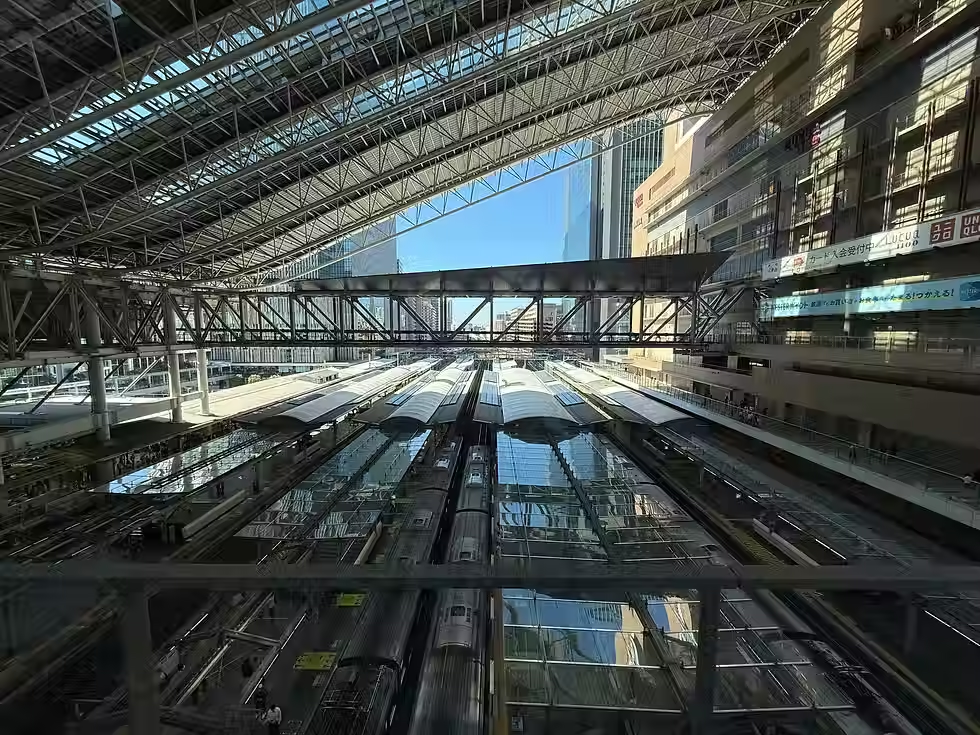
At JR Osaka Station, HARUKA uses the Umekita underground platforms, separate from the main elevated platforms. I would leave at least 15 minutes to find them from the main concourse, with extra time for luggage or ticket collection. The JR Osaka Station map shows the gates and connecting passages. Check the first or last train for your travel date.
Itami and Kobe airports
Osaka International Airport (Itami, ITM) serves domestic flights despite its name. Airport buses serve central Osaka, while the Osaka Monorail connects with Hankyu at Hotarugaike for Osaka-Umeda. Compare the bus’s final stop with the rail connection rather than choosing only by airport-to-city travel time.
Kobe Airport (UKB) is west of Osaka. The Port Liner takes about 18 minutes to Sannomiya, where you can change to JR, Hankyu or Hanshin for Osaka. Include that transfer when comparing flights into the three airports.
Arriving by train
Shin-Osaka is the Shinkansen station, north of the city’s main shopping districts. Continue by JR to Osaka Station, or take the Metro Midosuji Line toward Umeda, Namba and Tennoji. Osaka Station is the major JR hub in Umeda. Regional trains from Kyoto and Kobe can bring you directly there, while other railway companies arrive at their own stations.
Arriving on a cruise
Tempozan Passenger Terminal is on Osaka’s waterfront near the aquarium. Osakako Station on the Metro Chuo Line is about a five-minute walk away; the line connects with the Midosuji Line at Hommachi and JR at Bentencho. Confirm the berth on your cruise documents before arranging transport, as “Osaka” alone is not a sufficiently precise pickup address. With large bags, compare a taxi or cruise transfer with the station connections.
Collect booked tickets before heading to the platform
Our departure for Kansai Airport taught me this the hard way. I read the initial purchase confirmation but missed the fuller instructions in the email. At Osaka Station, collecting our tickets required both passports, which I had left with our luggage farther away. Repeated trips back and forth added about 1.5 miles (2.4 km), and I ended up running for our reserved train.
Check whether your booking requires paper-ticket collection and which machines or offices can issue it. For discounted HARUKA tickets booked directly through JR-WEST ONLINE TRAIN RESERVATION, bring the reservation number, the four-digit identification number chosen when booking, the same physical payment card and every traveler’s passport. The identification number is a booking code, not your credit-card PIN. Other ticket types and booking channels have different rules, so follow the collection instructions for your booking and keep the required documents together before leaving the hotel.
Getting Around
Exploring Osaka by public transport
The Metro is useful for crossing the city, JR connects several major districts and nearby cities, and private railways fill in other routes. These companies have separate fares and ticket rules even where their stations connect. A journey planner can find the route; the company name, line and station exit help you follow it on the ground.
Finding the right station and exit
Osaka and Umeda: JR Osaka Station, Hankyu Osaka-Umeda, Hanshin Osaka-Umeda and the Metro’s Umeda, Higashi-Umeda and Nishi-Umeda stations occupy the same broad district. They are linked by walkways and shopping passages, but transferring can involve a substantial walk. Follow the full station and operator name; Hankyu’s illustrated transfer guide shows how the separate stations connect.
Namba: Nankai Namba, Osaka Metro Namba, Osaka-Namba for Kintetsu and Hanshin, and JR Namba are different stations within a large area. For a Nankai airport train, follow Nankai signs rather than assuming any entrance marked Namba leads to your platform.
At any large station: check the line, direction and stopping pattern before boarding, then use the exit closest to your destination. If stairs are a concern, look for the lift route on the station map rather than relying on the nearest street entrance.
Useful rail routes for sightseeing
The Metro Midosuji Line links Shin-Osaka, Umeda, Shinsaibashi, Namba, Tennoji and Nagai. The Chuo Line is useful for the bay area. JR’s Osaka Loop Line serves Osaka, Osaka-jokoen, Morinomiya, Tennoji and other stops around the central city. On earlier visits, I enjoyed riding it for an above-ground view between districts. Check the destination display: some trains continue beyond the loop.
Our hotel’s direct connection to Keihan Nakanoshima Station made the journey to Temmabashi convenient for the river and castle area. That route needed a Keihan fare, even though we were still traveling within Osaka.
IC cards and passes: convenience versus coverage
A rechargeable IC card, such as ICOCA, pays individual fares from its balance. ICOCA, Suica, PASMO and other major cards are broadly interchangeable on participating rail and bus networks, so you usually do not need a new card for each city. Look for the IC symbol. Coverage is not universal, and you cannot assume a single through-journey across separate regional IC areas is accepted.
On a compatible iPhone or Apple Watch, you can add ICOCA, Suica or PASMO to Apple Wallet. Apple’s setup guide explains device and payment-card requirements. Android support depends on the transit app and compatible Osaifu-Keitai hardware; having Google Wallet alone is not enough. A physical IC card remains a useful alternative.
Tapping a bank card is a separate payment option. Osaka Metro accepts supported contactless bank cards at designated readers, but that does not make bank-card tapping interchangeable with an IC card across every railway and bus network.
An IC card does not automatically become a day pass or include limited-express supplements and reserved seats. A transport pass instead covers specified services for a set period. Osaka Metro’s Enjoy Eco Card covers Metro and eligible Osaka City Bus services, with exclusions including Yumeshima Station and certain bus routes. It does not cover JR or Keihan, Hankyu, Hanshin, Nankai and Kintetsu services. Compare the pass with the actual journeys on your plan, including any private-railway section of a through-running train.
Buses and hotel shuttles
Local buses give you a view of the streets and can save a station transfer. Our journey toward Dotonbori was enjoyable along Midosuji until we reached traffic near the busier streets. Rail is usually easier to plan around when you have a timed booking. Check the destination and bus stop in a current journey planner.
We used the RIHGA’s shuttle to Osaka Station as well as Keihan. The shuttle pickup is on the station’s west side near the Sakurabashi Exit, and seats are limited. Check your own hotel’s route and hours; a useful shuttle can make a hotel farther from the main station work well.
River cruises and boat tours
A sightseeing boat can be a comfortable break from walking. The Aqua-Liner explores the river around Osaka Castle and Nakanoshima; we enjoyed the rest, although the castle itself was visible only briefly. Choose a cruise for its waterways and city views, then visit the castle grounds separately if that is your main interest. Check the exact boarding pier, route and operating notice before going. We had to take a later departure because the first one we wanted was full.
Taxis and Uber
Taxis are useful for luggage, a late return or avoiding a long final walk. We took one back after Dotonbori when we were tired. Uber operates in Osaka and can book local taxis; check the available vehicle, pickup point and fare estimate in the app. Hotel staff can also help arrange a taxi. Have the destination’s Japanese address ready, especially for a small restaurant or a building with several entrances.
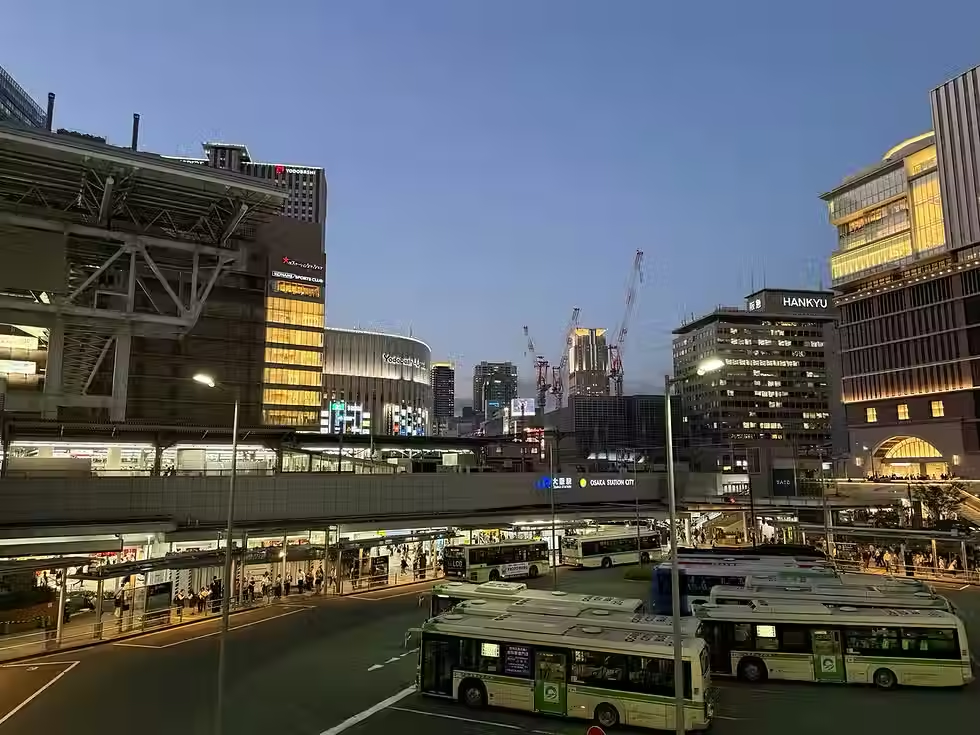
Buses line up beneath the station concourse at Osaka Station City as evening lights come on.
Money & Payments
Cash, cards and everyday purchases
Japan uses the yen. We paid by card in many places, but I would keep some cash for smaller businesses and purchases. At Tenjinbashisuji, even my massage could be paid by card; acceptance still varies from shop to shop, so check before ordering or booking.
Convenience stores were useful for early coffee, breakfast and small essentials. Department-store food floors offered a much wider choice when we wanted to browse. For a special offer, read the eligibility conditions: a massage promotion I noticed at Keihan City Mall was only for Japan residents, which I discovered when I asked to book.
Weather & What to Pack
Seasonal Weather in Osaka
Check the operator’s notice before a river cruise or an outdoor evening at teamLab, especially when strong wind, heavy rain or a typhoon is forecast. For an observatory, visibility matters as much as rain: a clear spell is worth using for the panorama.
Local Customs & Etiquette
Everyday courtesies
Keep conversations quiet on public transport, let passengers off before boarding and step aside before checking a map. Follow photography signs at shrines, exhibitions and shops, eat where the stall or venue permits, and take rubbish with you when there is no bin.
I still remember an earlier work trip when a colleague kept singing after we left karaoke. Our Japanese counterparts gently explained that the street was no longer the place for it. Osaka can be wonderfully lively, while the people around you still appreciate a quieter walk home.

Evening lights reflect in the water along Nakanoshima’s riverfront in Osaka.
Local Customs & Etiquette
Everyday courtesies
Keep conversations quiet on public transport, let passengers off before boarding and step aside before checking a map. Follow photography signs at shrines, exhibitions and shops, eat where the stall or venue permits, and take rubbish with you when there is no bin.
I still remember an earlier work trip when a colleague kept singing after we left karaoke. Our Japanese counterparts gently explained that the street was no longer the place for it. Osaka can be wonderfully lively, while the people around you still appreciate a quieter walk home.
THROUGH THE YEAR
When to Visit
Spring and autumn suit walking around Osaka, but the start and end of each season feel very different. March evenings can be chilly, September still feels like summer, and our October stay was hot. Choose dates for the weather you enjoy as well as blossoms, festivals or autumn color. The temperatures below span average monthly lows and highs within each season.
SPRING
March–May
March starts cool, while May can feel pleasantly warm. Blossom season and the Golden Week holidays bring stronger demand for accommodation.
Climate: Average daytime highs 14–25°C (58–77°F); overnight lows 6–16°C (43–61°F). Rain is possible throughout the season.
Seasonal highlight: Cherry blossoms brighten Osaka Castle Park and the Okawa riverside; the timing varies each year.
Outdoors and clothing: Wear layers, with a sweater and jacket for March, lighter tops for May and a compact umbrella.
Blossoms, warming days and busy holiday periods.
SUMMER
June–August
Summer brings humid heat, warm nights and lively festivals. Plan shorter outdoor walks with breaks indoors.
Climate: Average daytime highs 28–34°C (82–93°F); overnight lows 20–26°C (69–78°F). The early-summer rainy season gives way to stronger heat.
Seasonal highlight: Tenjin Matsuri brings processions and river celebrations in July.
Outdoors and clothing: Pack loose, breathable clothing, a sunhat and quick-drying footwear. Carry water, and keep a light layer for air-conditioning. Typhoons can disrupt outdoor plans.
Festival evenings, humid heat and indoor breaks.
FALL
September–November
September often still feels like summer, while November is much better suited to long walks. Our October stay was hot.
Climate: Average daytime highs 18–30°C (64–85°F); overnight lows 10–22°C (50–71°F). Autumn rain fronts and typhoons can affect travel.
Seasonal highlight: Later autumn brings color to the parks and more comfortable walks through Osaka’s smaller neighborhoods.
Outdoors and clothing: Begin with lightweight clothes for September; add long sleeves, a sweater and a jacket for November evenings. Check the forecast before packing.
Warm early autumn, cooler walks and late-season color.
WINTER
December–February
Winter is comparatively dry, with cool days and colder evenings. Food halls, museums and shopping streets fit naturally between outdoor stops.
Climate: Average daytime highs 10–12°C (49–54°F); overnight lows 3–5°C (37–42°F). Exposed riverfront walks can feel colder.
Seasonal highlight: Midosuji and Nakanoshima’s seasonal illuminations brighten the evenings. Check individual attraction openings around New Year.
Outdoors and clothing: Bring a warm coat, sweater, long trousers and closed shoes; a scarf and gloves help beside the river.
Illuminated streets, museums and cold evenings.
Cherry branches frame the broad moat and high stone walls of Osaka Castle in spring.
Good to Know
Addresses, language and manageable walking
Save the building and floor as well as the name of a restaurant. Around Umeda, a map pin can put you beside the correct complex while the entrance is on another level. We enjoyed Hankyu’s basement food floor and its upper restaurant floors, but moving between neighboring buildings could take longer than expected.
Download Japanese in your translation app and prepare a short question before approaching someone. Showing the destination or booking confirmation is often simpler than explaining a complicated route.
Include station corridors and park approaches when judging how much walking a day involves. We often returned to the hotel in the afternoon and went out again for dinner or teamLab. That worked well in the hot weather and left us with more energy for the evening.
Traveling with luggage: Ask your hotel about luggage forwarding, such as Yamato’s TA-Q-BIN, between Kyoto and Osaka hotels or between Kansai Airport and participating hotels. Confirm that the receiving hotel accepts bags and agree on the delivery day before sending. For delivery to the airport, Yamato’s Airport TA-Q-BIN generally needs dispatch at least two days before your flight, or three from some areas. Check the local cutoff and keep essentials with you.
Final Thoughts
Osaka became easier once we matched the transport to each outing and allowed time for the walks between it all. Settle the arrival route, understand your ticket and keep the day’s destinations reasonably close together. That leaves more time to enjoy the smaller streets, food and riverfront.